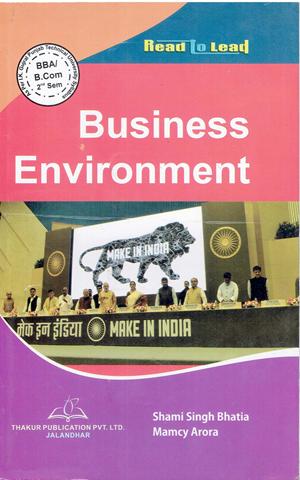
Title: Business Environment for BBA & BCom 2nd Semester, PTU by Shami Singh Bhatia & Mamcy Arora | Thakur Publishers
This book, "Business Environment," is meticulously crafted as a comprehensive and syllabus-specific guide for students pursuing Bachelor of Business Administration (BBA) and Bachelor of Commerce (BCom) at Punjab Technical University (PTU) in their second semester. Authored by Shami Singh Bhatia and Mamcy Arora and published by Thakur Publishers, this book is an indispensable academic resource designed to provide a clear and structured understanding of the dynamic external forces that shape modern business operations.
Structured in perfect alignment with the prescribed PTU syllabus, the book systematically covers all critical units. It begins with a foundational introduction to the business environment, explaining its nature, significance, and components. Students are introduced to essential concepts like environmental scanning and the structure of various economic systems. The unit provides a detailed overview of India's economic framework, including economic planning, industrial policy, fiscal policy, monetary policy, and the EXIM policy, forming a solid base for understanding the macroeconomic landscape.
The second unit delves into the political and legal environment of business, a critical area for any aspiring business professional. It elaborates on the roles of the legislature, executive, and judiciary in shaping business conduct. Key legislations such as the Foreign Exchange Management Act (FEMA) and the Consumer Protection Act, 1986, are explained with clarity. Furthermore, this section provides a crucial analysis of the Liberalization, Privatization, and Globalization (LPG) model, discussing the factors that have both facilitated and impeded globalization in the Indian context.
Unit three explores the socio-cultural and technological environment, addressing the soft yet powerful influences on business. It covers the critical elements of the socio-cultural milieu and delves into the ethical dimensions of business through chapters on Corporate Social Responsibility (CSR) and Business Ethics. This unit also examines the evolving role and relevance of the public sector in India and its reforms. Additionally, it provides a clear regulatory framework for the banking market and the security market, alongside an analysis of the rapidly evolving technological environment.
The final unit expands the perspective to the international business environment. It offers insights into the functioning, benefits, and challenges of Multinational Corporations (MNCs) and explains the strategic rationale behind Mergers and Acquisitions. The book provides a detailed examination of global economic institutions and agreements, including the World Trade Organization (WTO) and its consequences for India, the International Monetary Fund (IMF), and the various regional groupings that influence international trade.
Key features of this PTU-centric book include:
1. Strict Syllabus Adherence: The content is meticulously organized to match the latest PTU syllabus for BBA and BCom 2nd Semester, ensuring no topic is left uncovered.
2. Clear and Structured Content: Each chapter is presented in a lucid and point-wise manner, facilitating easy comprehension and efficient revision.
3. Chapter-wise Exercises: Every unit concludes with a dedicated exercise section, allowing students to self-assess their understanding and prepare effectively for university examinations.
4. Examination-Oriented Approach: The content is tailored to help students answer questions precisely as expected in PTU examinations.
5. Relevant Case Studies and Examples: The inclusion of contemporary examples, including Indian case studies, helps bridge the gap between theoretical concepts and real-world business scenarios.
This book is not just a book but a complete learning package for PTU students aiming to master the subject of business environment. It is an essential investment for securing high marks and building a strong foundational knowledge of how businesses interact with and are influenced by their economic, legal, social, and global surroundings.









.jpg)