Categories
College Bookssss >
BA PU Chandigarh
BSC PU Chandigarh
MSC PU Chandigarh
BBA PU Chandigarh
MA PU Chandigarh
Medical Books
Engineering Books
Management Books
PGDCA Books
BCOM PU Chandigarh
MCOM PU Chandigarh
BCA PU Chandigarh
MCA PU Chandigarh
animate-books

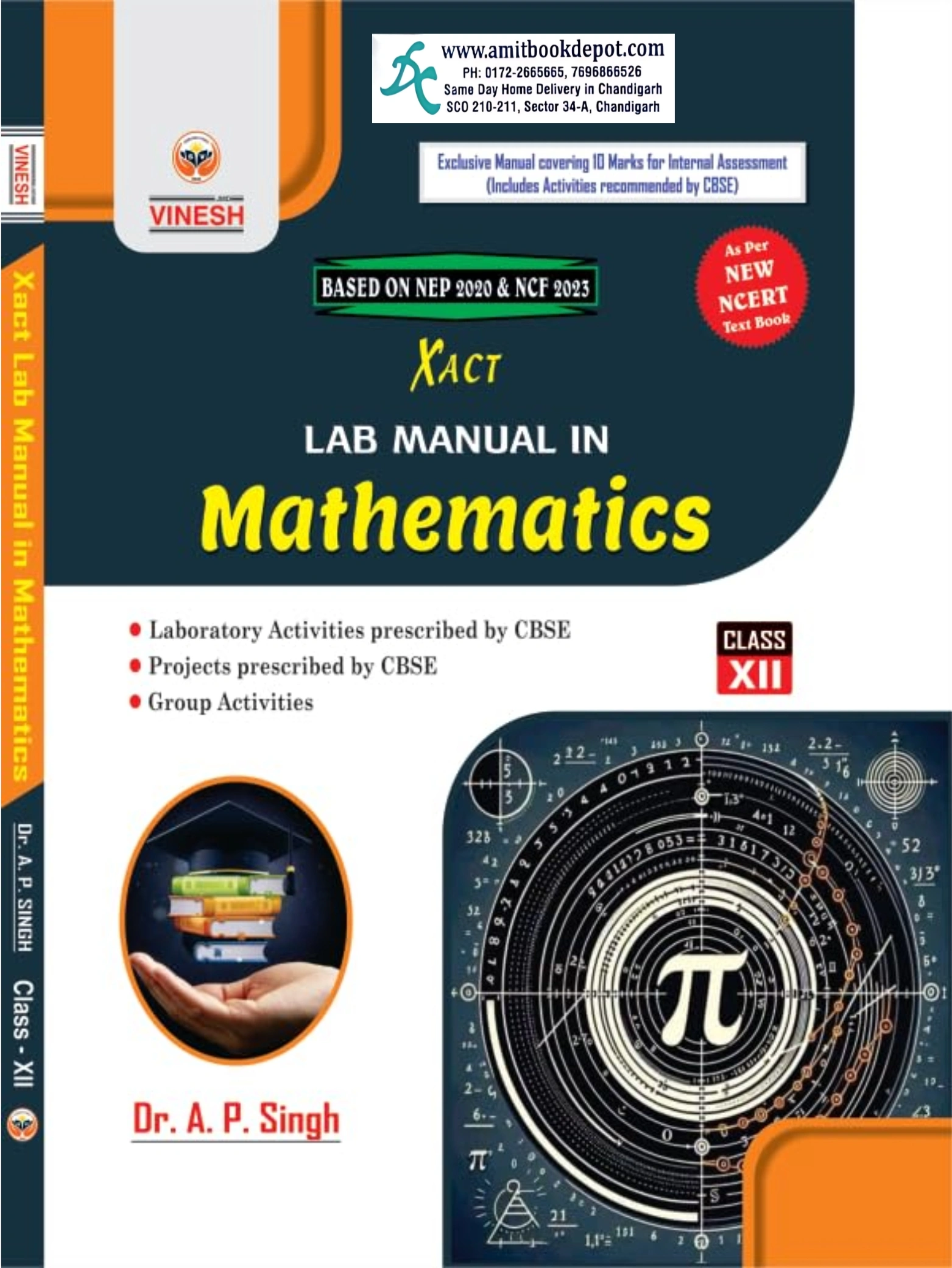
Vinesh Xact Manual in Mathematics For Class 12th

by Madhurima
โ‚น360 โ‚น360.00(-/ off)

Rating & Reviews

23 Customer Review

The Vinesh Xact Manual in Mathematics for Class 12 by Dr. A. P. Singh (Dinesh Publications) is the complete CBSE Mathematics Lab Manual for 2024-25. It meticulously covers all 21 NCERT Lab Activities and Projects for Internal Assessment (20 marks). This essential guide provides step-by-step instructions for activities on relations, functions, calculus, vectors, 3D geometry, and probability. It includes a detailed list of required lab equipment and models, helping students perfectly maintain their activity record file and prepare for viva voce. Achieve full marks in practicals and strengthen your board exam preparation with this definitive activity-based learning resource.

Have Doubts Regarding This Product ? Ask Your Question

  • Q1
    Does this manual contain all the activities exactly as prescribed by the latest CBSE syllabus?
    A1

    Yes, it comprehensively covers all 21 lab activities and project suggestions as per the latest NCERT/CBSE guidelines for Class 12 Mathematics practical assessment.

  • Q2
    How does this book help in scoring the full 20 marks in Internal Assessment?
    A2

    It provides the exact material needed for all three components: performing activities (5 marks), preparing for the year-end activity test (3 marks), and viva voce preparation (2 marks).

  • Q3
    Are the instructions for model-making and activities suitable for self-study at home?
    A3

    While designed for lab settings, the clear, step-by-step instructions and listed materials allow students to understand and simulate many activities at home with basic stationery.

  • Q4
    Is the list of equipment and models provided in the book just for the school, or can students use it too?
    A4

    It serves as a crucial checklist for students to ensure they use the correct tools during lab sessions and understand what models will be used for demonstration by the teacher.

  • Q5
    Does this manual only cover practical work, or does it also help with theory exam preparation?
    A5

    While focused on practicals, the hands-on activities deeply reinforce theoretical concepts from chapters like Calculus, Vectors, and 3D Geometry, indirectly aiding theory exam preparation.

  • Q6
    How is the "List of Mathematicians" section useful for my exams?
    A6

    This section provides contextual knowledge that can be valuable during viva voce and adds depth to your understanding of mathematical concepts, showcasing well-rounded learning.

  • Q7
    Is this book useful for competitive exams like JEE or NEET alongside board prep?
    A7

    Its primary focus is CBSE practicals. However, the strong conceptual clarity gained from performing activities, especially in Calculus and Geometry, can provide a solid foundation for competitive exams.

  • Q8
    Does it include activities for the "Application of Derivatives" chapter, which is often challenging?
    A8

    Yes, it includes multiple dedicated activities (Lab Activities 11-16) on Increasing/Decreasing Functions, Maxima/Minima, and their practical Applications, making these concepts clearer.

  • Q9
    Are the activities on Inverse Trigonometric Functions covered in detail?
    A9

    Yes, Lab Activities 5 & 6 specifically focus on Graphs and Principal Values of Inverse Trigonometric Functions, providing hands-on exploration of these topics.

  • Q10
    As a teacher, can I use this manual to plan my mathematics lab schedule for the year?
    A10

    Definitely. It is an excellent resource for teachers to structure the annual lab curriculum, ensure all required activities are covered, and prepare the necessary equipment and models listed in the manual.

0.00

0 Overall Rating
  • 5
    0
  • 4
    0
  • 3
    0
  • 2
    0
  • 1
    0

Try this product & share your review & thoughts

Lab Activity 1: Types of Relations
Lab Activity 2: Equivalence Relations
Lab Activity 3: Functions (One-to-One/Onto) - I
Lab Activity 4: Functions (One-to-One/Onto) - II
Lab Activity 5: Graph of Inverse Trigonometrical Functions
Lab Activity 6: Principal Value of Inverse Trigonometrical Functions
Lab Activity 7: Calculus (Sketching of Graph)
Lab Activity 8: Relationship between Common Logarithm and Natural Logarithm
Lab Activity 9: Limits
Lab Activity 10: Continuity
Lab Activity 11: Increasing and Decreasing Functions
Lab Activity 12: Local Maxima and Minima
Lab Activity 13: Absolute Maxima and Minima
Lab Activity 14: Application of Maxima and Minima - I
Lab Activity 15: Application of Maxima and Minima - II
Lab Activity 16: Application of Maxima and Minima - III
Lab Activity 17: Vectors (Distributive Property)
Lab Activity 18: Vectors
Lab Activity 19: Three-Dimensional Geometry
Lab Activity 20: Plane (Shortest Distance)
Lab Activity 21: Probability
- Projects suggested by NCERT

PROJECTS

Project I: Calculus
Project II: Differential Equations
Project III: Three-Dimensional Geometry
Project IV: Linear Programming Problem

List of Mathematicians

Latest Syllabus of Xact Manual in Mathematics for Class 12th


The following weightages are assigned for evaluation at the higher secondary stage in mathematics.
Theory Examination: 80 marks
Internal Assessment: 20 marks
(a) Periodic text: 10 marks
(b) Activities: 10 marks

Assessment of Activity Work:
Throughout the year any 10 activities shall be performed by the student from the activities given in the Laboratory Manual. A record of the same may be kept by the student. A year-end test on the activity may be conducted at the school level.

The weightage is as under:
1. The activities performed by the student throughout the year and record keeping: 5 marks
2. Assessment of the activity performed during the year-end test: 3 marks
3. Viva voce: 2 marks

Equipment for Mathematics Laboratory at the Higher Secondary Stage

As the students will be involved in a lot of model-making activities under the guidance of the teacher, the smooth running of the mathematics laboratory will depend upon the supply of oddments such as strings and threads, cellotape, white cardboard, hardboard, needles and pins, drawing pins, sandpaper, pliers, screwdrivers, rubber bands of different colors, gummed papers and labels, squared paper, plywood, scissors, saws, paint, soldering, solder wire, steel, etc. made up of good durable sheets, glazed papers, etc. Besides these, some models, charts, slides, etc., made up of a good durable material should also be there for the teacher to demonstrate some mathematical concepts, facts, and properties before the students. Different tables and a ready reckoner should also be there (in the laminated form) so that these can be used by the students for different purposes. Further, there should be equipment like mathematical instruments, calculators, computers, books, journals, mathematical dictionaries, etc., in the laboratory.
In view of the above, the following is the list of suggested instruments/models for the laboratory:

EQUIPMENT

Mathematical instrument set (wooden geometry box for demonstration containing rulers, set squares, dividers, protractors, and compasses), some geometry boxes, meter scales of 100 cm, 50 cm, and 30 cm, measuring tape, diagonal scale, clinometer, calculators, computers including related software, etc.

MODELS FOR DEMONSTRATION OF-

- Set
- Relations and Functions
- Quadratic functions with the help of linear functions
- Sequence and Series
- Pascalโ€™s triangle
- Arithmetic Progression
- Conic Sections
- Increasing decreasing functions
- Maxima, minima, point of inflection
- Lagrangeโ€™s minima, point of inflection
- Angle in semicircle using vectors
- Construction of a parabola when the distance between the directrix and focus is given 
- Construction of ellipse when major and minor axes are given
- Octants
- Shortest distance between two skew lines
- Geometrical interpretation of scalar and vector products
- Equation of a straight line passing through a fixed point and parallel to a given vector
- Equation to a plane
- Projection of the line segment
- Sample spaces
- Conditional Probability

STATIONERY AND ODDMENTS

Rubber bands of different colors, marbles of different colors, a pack of playing cards, graph paper/squared paper, dotted paper, drawing pins, erasers, pencils, sketch pens, cellotape, threads of different colors, glazed papers, kite papers, tracing papers, adhesive, pins, scissors and cutters, hammers, a saw, thermocol sheets, sandpaper, nails and screws of different sizes, screwdrivers, a drill machine with a bit set, and pliers.

Master CBSE Class 12 Mathematics with the Definitive Activity-Based Learning Manual: Vinesh Xact Manual in Mathematics for Class 12

The Vinesh Xact Manual in Mathematics for Class 12 is an indispensable, curriculum-aligned resource meticulously designed to empower students to excel in both the theoretical and practical components of the CBSE board examination. Authored by the esteemed Dr. A. P. Singh and published by the renowned Dinesh Publications Pvt. Ltd., this comprehensive manual bridges the gap between abstract mathematical concepts and tangible, hands-on understanding. It is specifically engineered to fulfill the CBSE Class 12 Mathematics syllabus requirements for the Internal Assessment, which carries a significant 20 marks, while simultaneously reinforcing core concepts tested in the 80-mark Theory Examination.

This manual is far more than a traditional book; it is a complete Mathematics Lab Manual and Activity Guide. It provides a structured, step-by-step framework for students to successfully execute and document the laboratory activities mandated by the National Council of Educational Research and Training (NCERT). The content is strategically organized into 21 detailed lab activities covering the most crucial and often challenging topics of Class 12 Maths. From establishing a solid foundation in relations and functions, including equivalence relations and one-to-one/onto functions, to navigating the complexities of calculusโ€”such as limits, continuity, derivatives, and applications of derivatives for finding local maxima and minima and absolute maxima and minimaโ€”this manual offers clear guidance. It further extends to inverse trigonometric functions, vectors, three-dimensional geometry, and probability, ensuring holistic coverage.

A standout feature of this Vinesh Xact Manual is its dedicated section on projects, which aligns perfectly with NCERT-suggested projects. It provides actionable ideas and frameworks for projects on differential equations, three-dimensional geometry, and linear programming problems, enabling students to produce high-quality, insightful work that can secure top marks in the internal evaluation. The inclusion of a list of mathematicians adds valuable context and enrichment to the student's learning journey.

Understanding the practical logistics of a mathematics laboratory, this manual includes an exhaustive syllabus-specific list of required equipment, models, and stationery. This list acts as an essential checklist for schools and students to set up an effective lab environment. It details everything from mathematical instruments like geometry boxes, clinometers, and measuring tapes to models for demonstration (e.g., for conic sections, Pascalโ€™s triangle, and skew lines) and the necessary oddments such as graph paper, rubber bands, threads, and tools. This ensures that activities are not just theoretical exercises but are performed with the correct physical tools, deepening conceptual clarity.

For students aiming to maximize their Internal Assessment score of 20 marks, this book is a strategic asset. It directly addresses the CBSE evaluation pattern: 5 marks for regular activity performance and record-keeping, 3 marks for a year-end activity test, and 2 marks for the viva voce. By systematically working through the prescribed lab activities and projects in this manual, students can methodically prepare their activity record file, build confidence for the practical test, and be thoroughly prepared for oral assessments. The Xact methodology emphasizes precision, clarity, and exam-oriented practice, making it a trusted companion for board exam preparation.

In summary, the Vinesh Xact Manual in Mathematics for Class 12 by Dr. A. P. Singh is the ultimate, all-in-one solution for mastering the practical curriculum. It is an essential purchase for every Class 12 CBSE student seeking to build a strong conceptual foundation through activity-based learning, achieve a perfect score in internal assessment, and gain a competitive edge in the final board examinations.

Lab Activity 1: Types of Relations
Lab Activity 2: Equivalence Relations
Lab Activity 3: Functions (One-to-One/Onto) - I
Lab Activity 4: Functions (One-to-One/Onto) - II
Lab Activity 5: Graph of Inverse Trigonometrical Functions
Lab Activity 6: Principal Value of Inverse Trigonometrical Functions
Lab Activity 7: Calculus (Sketching of Graph)
Lab Activity 8: Relationship between Common Logarithm and Natural Logarithm
Lab Activity 9: Limits
Lab Activity 10: Continuity
Lab Activity 11: Increasing and Decreasing Functions
Lab Activity 12: Local Maxima and Minima
Lab Activity 13: Absolute Maxima and Minima
Lab Activity 14: Application of Maxima and Minima - I
Lab Activity 15: Application of Maxima and Minima - II
Lab Activity 16: Application of Maxima and Minima - III
Lab Activity 17: Vectors (Distributive Property)
Lab Activity 18: Vectors
Lab Activity 19: Three-Dimensional Geometry
Lab Activity 20: Plane (Shortest Distance)
Lab Activity 21: Probability
- Projects suggested by NCERT

PROJECTS

Project I: Calculus
Project II: Differential Equations
Project III: Three-Dimensional Geometry
Project IV: Linear Programming Problem

List of Mathematicians

Have Doubts Regarding This Product ? Ask Your Question

  • Q1
    Does this manual contain all the activities exactly as prescribed by the latest CBSE syllabus?
    A1

    Yes, it comprehensively covers all 21 lab activities and project suggestions as per the latest NCERT/CBSE guidelines for Class 12 Mathematics practical assessment.

  • Q2
    How does this book help in scoring the full 20 marks in Internal Assessment?
    A2

    It provides the exact material needed for all three components: performing activities (5 marks), preparing for the year-end activity test (3 marks), and viva voce preparation (2 marks).

  • Q3
    Are the instructions for model-making and activities suitable for self-study at home?
    A3

    While designed for lab settings, the clear, step-by-step instructions and listed materials allow students to understand and simulate many activities at home with basic stationery.

  • Q4
    Is the list of equipment and models provided in the book just for the school, or can students use it too?
    A4

    It serves as a crucial checklist for students to ensure they use the correct tools during lab sessions and understand what models will be used for demonstration by the teacher.

  • Q5
    Does this manual only cover practical work, or does it also help with theory exam preparation?
    A5

    While focused on practicals, the hands-on activities deeply reinforce theoretical concepts from chapters like Calculus, Vectors, and 3D Geometry, indirectly aiding theory exam preparation.

  • Q6
    How is the "List of Mathematicians" section useful for my exams?
    A6

    This section provides contextual knowledge that can be valuable during viva voce and adds depth to your understanding of mathematical concepts, showcasing well-rounded learning.

  • Q7
    Is this book useful for competitive exams like JEE or NEET alongside board prep?
    A7

    Its primary focus is CBSE practicals. However, the strong conceptual clarity gained from performing activities, especially in Calculus and Geometry, can provide a solid foundation for competitive exams.

  • Q8
    Does it include activities for the "Application of Derivatives" chapter, which is often challenging?
    A8

    Yes, it includes multiple dedicated activities (Lab Activities 11-16) on Increasing/Decreasing Functions, Maxima/Minima, and their practical Applications, making these concepts clearer.

  • Q9
    Are the activities on Inverse Trigonometric Functions covered in detail?
    A9

    Yes, Lab Activities 5 & 6 specifically focus on Graphs and Principal Values of Inverse Trigonometric Functions, providing hands-on exploration of these topics.

  • Q10
    As a teacher, can I use this manual to plan my mathematics lab schedule for the year?
    A10

    Definitely. It is an excellent resource for teachers to structure the annual lab curriculum, ensure all required activities are covered, and prepare the necessary equipment and models listed in the manual.

Latest Syllabus of Xact Manual in Mathematics for Class 12th


The following weightages are assigned for evaluation at the higher secondary stage in mathematics.
Theory Examination: 80 marks
Internal Assessment: 20 marks
(a) Periodic text: 10 marks
(b) Activities: 10 marks

Assessment of Activity Work:
Throughout the year any 10 activities shall be performed by the student from the activities given in the Laboratory Manual. A record of the same may be kept by the student. A year-end test on the activity may be conducted at the school level.

The weightage is as under:
1. The activities performed by the student throughout the year and record keeping: 5 marks
2. Assessment of the activity performed during the year-end test: 3 marks
3. Viva voce: 2 marks

Equipment for Mathematics Laboratory at the Higher Secondary Stage

As the students will be involved in a lot of model-making activities under the guidance of the teacher, the smooth running of the mathematics laboratory will depend upon the supply of oddments such as strings and threads, cellotape, white cardboard, hardboard, needles and pins, drawing pins, sandpaper, pliers, screwdrivers, rubber bands of different colors, gummed papers and labels, squared paper, plywood, scissors, saws, paint, soldering, solder wire, steel, etc. made up of good durable sheets, glazed papers, etc. Besides these, some models, charts, slides, etc., made up of a good durable material should also be there for the teacher to demonstrate some mathematical concepts, facts, and properties before the students. Different tables and a ready reckoner should also be there (in the laminated form) so that these can be used by the students for different purposes. Further, there should be equipment like mathematical instruments, calculators, computers, books, journals, mathematical dictionaries, etc., in the laboratory.
In view of the above, the following is the list of suggested instruments/models for the laboratory:

EQUIPMENT

Mathematical instrument set (wooden geometry box for demonstration containing rulers, set squares, dividers, protractors, and compasses), some geometry boxes, meter scales of 100 cm, 50 cm, and 30 cm, measuring tape, diagonal scale, clinometer, calculators, computers including related software, etc.

MODELS FOR DEMONSTRATION OF-

- Set
- Relations and Functions
- Quadratic functions with the help of linear functions
- Sequence and Series
- Pascalโ€™s triangle
- Arithmetic Progression
- Conic Sections
- Increasing decreasing functions
- Maxima, minima, point of inflection
- Lagrangeโ€™s minima, point of inflection
- Angle in semicircle using vectors
- Construction of a parabola when the distance between the directrix and focus is given 
- Construction of ellipse when major and minor axes are given
- Octants
- Shortest distance between two skew lines
- Geometrical interpretation of scalar and vector products
- Equation of a straight line passing through a fixed point and parallel to a given vector
- Equation to a plane
- Projection of the line segment
- Sample spaces
- Conditional Probability

STATIONERY AND ODDMENTS

Rubber bands of different colors, marbles of different colors, a pack of playing cards, graph paper/squared paper, dotted paper, drawing pins, erasers, pencils, sketch pens, cellotape, threads of different colors, glazed papers, kite papers, tracing papers, adhesive, pins, scissors and cutters, hammers, a saw, thermocol sheets, sandpaper, nails and screws of different sizes, screwdrivers, a drill machine with a bit set, and pliers.

0.00

0 Overall Rating
  • 5
    0
  • 4
    0
  • 3
    0
  • 2
    0
  • 1
    0

Try this product & share your review & thoughts

Top Trending Product

Related Product

Related Product

Related Blog Posts

Latest Blogs

Latest Blogs

blog-img
Classic Literature Reimagined: Discuss modern twists on classic novels.
Lorem ipsum dolor sit amet, consectetur adipiscing elit, sed do eiusmod tempor incididunt ut labore et dolore magna aliqua. Ut enim ad minim veniam, quis nostrud exercitation ullamco Lorem ipsum dolor sit amet, consectetur adipiscing elit, sed do eiusmod tempor incididunt ut labore et dolore magna aliqua. Utenim ad minim veniam, quis nostrud exercitation ullamco Lorem ipsum dolor sit amet, consecte...
Read more
Author name | 10 jan, 2025
blog-img
Classic Literature Reimagined: Discuss modern twists on classic novels.
Lorem ipsum dolor sit amet, consectetur adipiscing elit, sed do eiusmod tempor incididunt ut labore et dolore magna aliqua. Ut enim ad minim veniam, quis nostrud exercitation ullamco Lorem ipsum dolor sit amet, consectetur adipiscing elit, sed do eiusmod tempor incididunt ut labore et dolore magna aliqua. Utenim ad minim veniam, quis nostrud exercitation ullamco Lorem ipsum dolor sit amet, consecte...
Read more
Author name | 10 jan, 2025
blog-img
Classic Literature Reimagined: Discuss modern twists on classic novels.
Lorem ipsum dolor sit amet, consectetur adipiscing elit, sed do eiusmod tempor incididunt ut labore et dolore magna aliqua. Ut enim ad minim veniam, quis nostrud exercitation ullamco Lorem ipsum dolor sit amet, consectetur adipiscing elit, sed do eiusmod tempor incididunt ut labore et dolore magna aliqua. Utenim ad minim veniam, quis nostrud exercitation ullamco Lorem ipsum dolor sit amet, consecte...
Read more
Author name | 10 jan, 2025
blog-img
Classic Literature Reimagined: Discuss modern twists on classic novels.
Lorem ipsum dolor sit amet, consectetur adipiscing elit...
Read more
Author Name | 10 Jan, 2025
blog-img
Classic Literature Reimagined: Discuss modern twists on classic novels.
Lorem ipsum dolor sit amet, consectetur adipiscing elit...
Read more
Author Name | 10 Jan, 2025
blog-img
Classic Literature Reimagined: Discuss modern twists on classic novels.
Lorem ipsum dolor sit amet, consectetur adipiscing elit...
Read more
Author Name | 10 Jan, 2025
blog-img
Classic Literature Reimagined: Discuss modern twists on classic novels.
Lorem ipsum dolor sit amet, consectetur adipiscing elit...
Read more
Author Name | 10 Jan, 2025
blog-img
Classic Literature Reimagined: Discuss modern twists on classic novels.
Lorem ipsum dolor sit amet, consectetur adipiscing elit...
Read more
Author Name | 10 Jan, 2025
blog-img
Classic Literature Reimagined: Discuss modern twists on classic novels.
Lorem ipsum dolor sit amet, consectetur adipiscing elit...
Read more
Author Name | 10 Jan, 2025
blog-img
Classic Literature Reimagined: Discuss modern twists on classic novels.
Lorem ipsum dolor sit amet, consectetur adipiscing elit...
Read more
Author Name | 10 Jan, 2025
blog-img
Classic Literature Reimagined: Discuss modern twists on classic novels.
Lorem ipsum dolor sit amet, consectetur adipiscing elit...
Read more
Author Name | 10 Jan, 2025
blog-img
Classic Literature Reimagined: Discuss modern twists on classic novels.
Lorem ipsum dolor sit amet, consectetur adipiscing elit...
Read more
Author Name | 10 Jan, 2025