-
Mon-Fri: 10AM to 8PM 01722665665
-
My Account
-
-
0
Total :
₹ 0.00

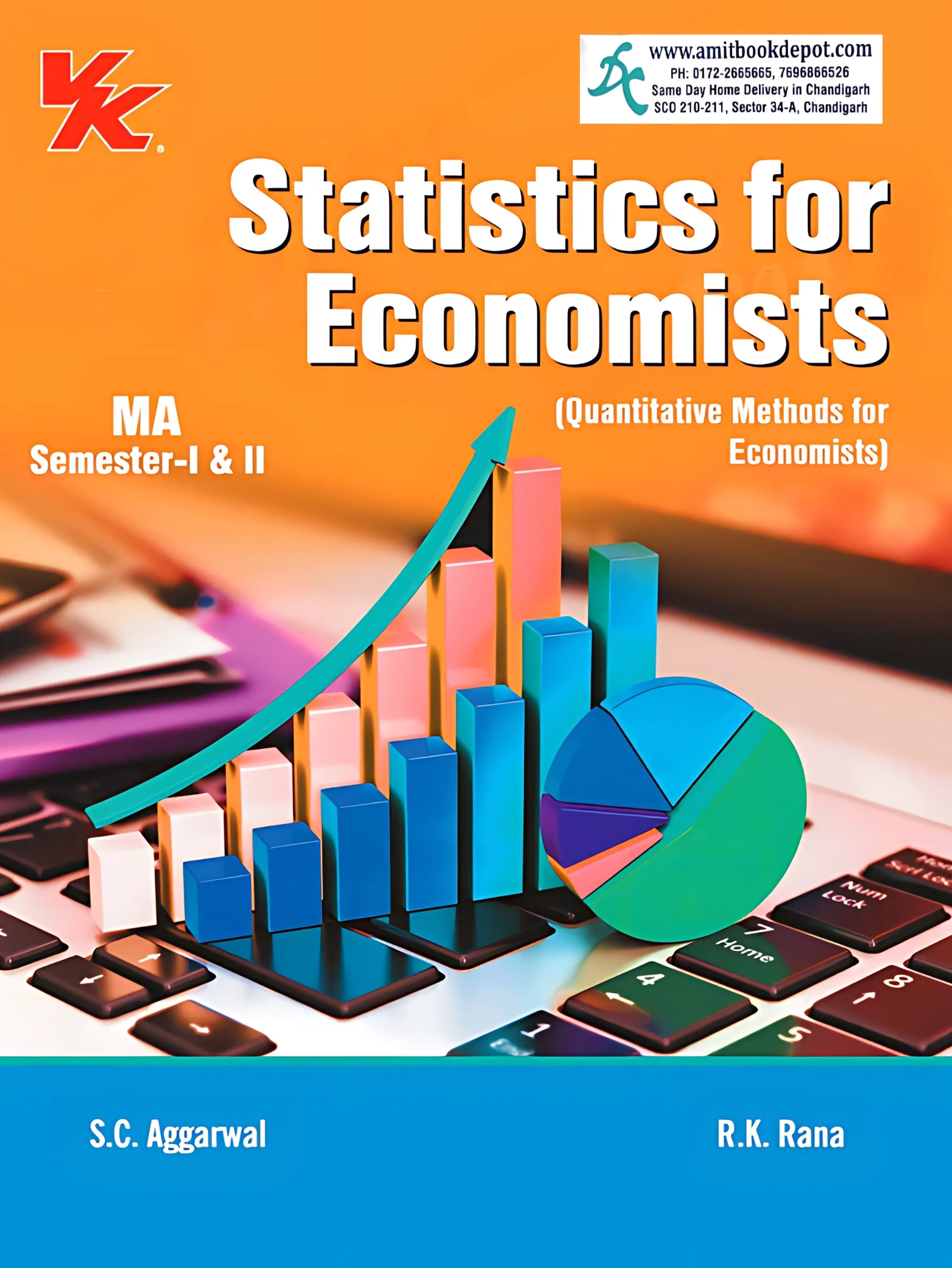

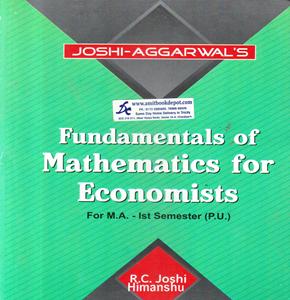
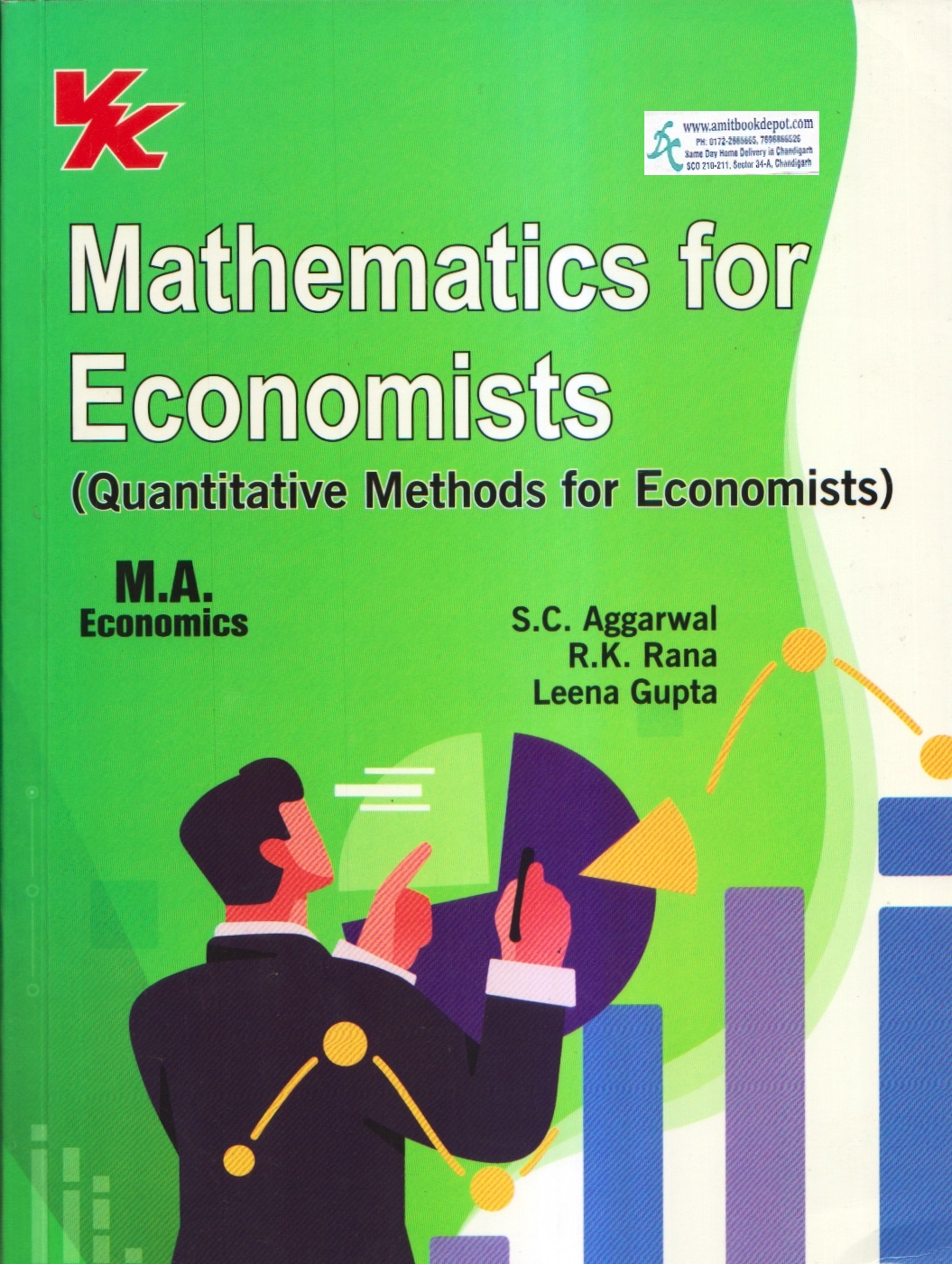
Yes, it is a comprehensive resource that covers all mathematical tools (like Differentiation, Integration, Matrices, Linear Programming) and statistical concepts (Probability, Inference, Regression) as per the unified syllabus for MAECO-103 and MAECO-203.
Yes, the book contains a dedicated section titled "Advanced Statistical Tables" at the end, which includes all the necessary tables mandated by the Panjab University exam instructions.
Absolutely. The book details the formulation of Linear Programming Problems (LPP) and provides step-by-step solutions using both the Graphical Method and the Simplex Method, including interpretation of the Dual problem.
The book covers Multiple Regression Analysis with up to two explanatory variables, including interpretation of coefficients, R², and Adjusted R², along with an appendix note on R², which is crucial for the syllabus.
Yes, it has specific sections on the "Application of Derivatives" for optimization (cost, revenue) and elasticity, and "Application of Integration" for calculating Consumer's and Producer's Surplus, directly linking calculus to economic problems.
Yes, the book provides an introduction to these equations, their solutions, and dedicated sections on "Economic Applications" concerning demand, revenue, cost functions, and simple market equilibrium models.
Yes, the chapters on Binomial, Poisson, and Normal distributions explicitly cover their properties, including the derivation of mean and variance, as required by the syllabus.
Yes, Chapter 14 on Estimation Theory covers concepts of estimators, their properties (unbiasedness, consistency, etc.), and details Interval Estimation and Confidence Intervals for various parameters like mean and proportion.
Yes, the book covers Constrained Optimization using Lagrange’s method under the Differentiation topic in Unit-I of the Semester I syllabus.
The dedicated ANOVA chapter covers applications for both one-way and two-way classifications, aligning perfectly with the syllabus requirements for Unit-IV of Semester II.
No Description Added
Yes, it is a comprehensive resource that covers all mathematical tools (like Differentiation, Integration, Matrices, Linear Programming) and statistical concepts (Probability, Inference, Regression) as per the unified syllabus for MAECO-103 and MAECO-203.
Yes, the book contains a dedicated section titled "Advanced Statistical Tables" at the end, which includes all the necessary tables mandated by the Panjab University exam instructions.
Absolutely. The book details the formulation of Linear Programming Problems (LPP) and provides step-by-step solutions using both the Graphical Method and the Simplex Method, including interpretation of the Dual problem.
The book covers Multiple Regression Analysis with up to two explanatory variables, including interpretation of coefficients, R², and Adjusted R², along with an appendix note on R², which is crucial for the syllabus.
Yes, it has specific sections on the "Application of Derivatives" for optimization (cost, revenue) and elasticity, and "Application of Integration" for calculating Consumer's and Producer's Surplus, directly linking calculus to economic problems.
Yes, the book provides an introduction to these equations, their solutions, and dedicated sections on "Economic Applications" concerning demand, revenue, cost functions, and simple market equilibrium models.
Yes, the chapters on Binomial, Poisson, and Normal distributions explicitly cover their properties, including the derivation of mean and variance, as required by the syllabus.
Yes, Chapter 14 on Estimation Theory covers concepts of estimators, their properties (unbiasedness, consistency, etc.), and details Interval Estimation and Confidence Intervals for various parameters like mean and proportion.
Yes, the book covers Constrained Optimization using Lagrange’s method under the Differentiation topic in Unit-I of the Semester I syllabus.
The dedicated ANOVA chapter covers applications for both one-way and two-way classifications, aligning perfectly with the syllabus requirements for Unit-IV of Semester II.