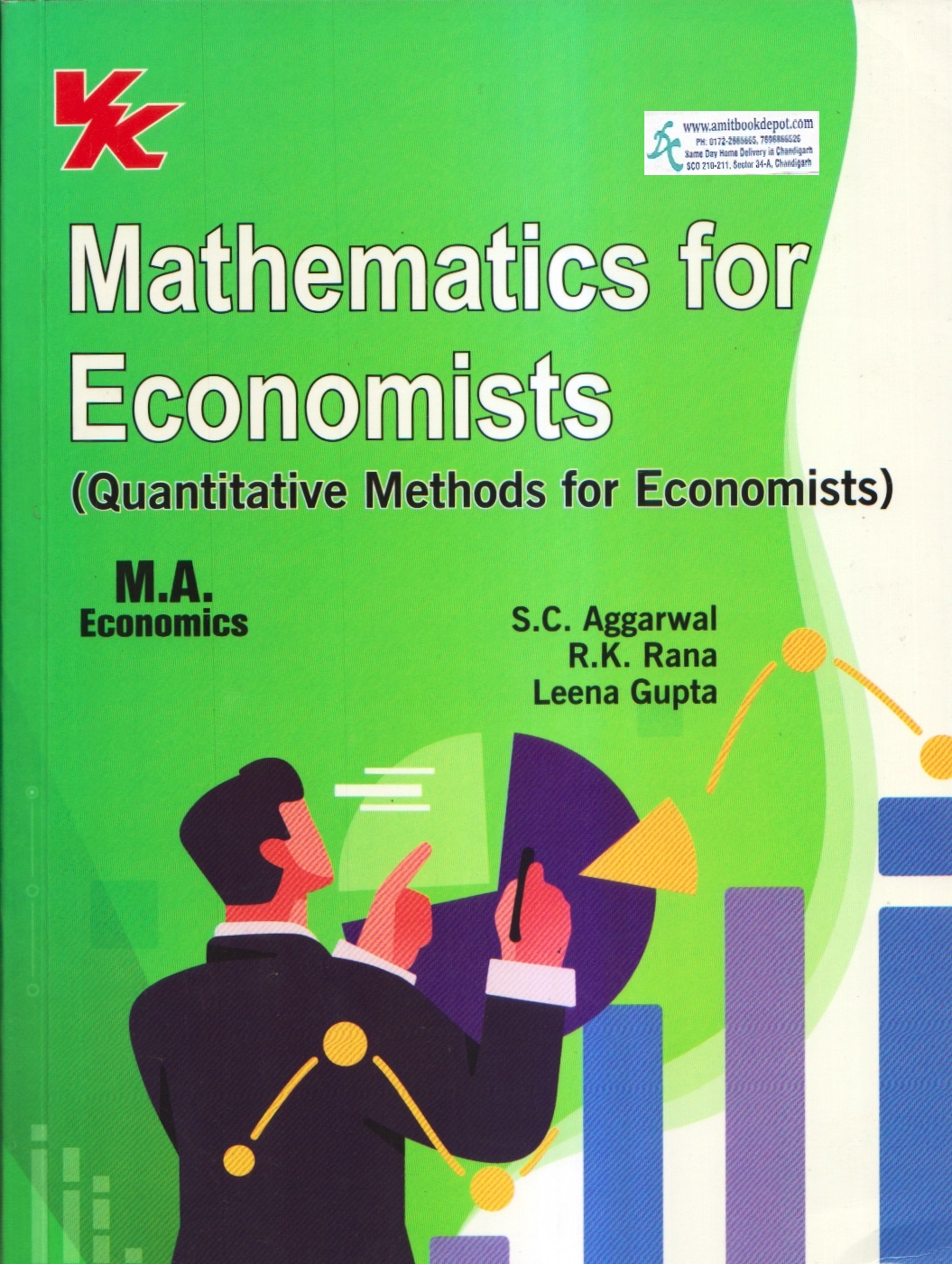
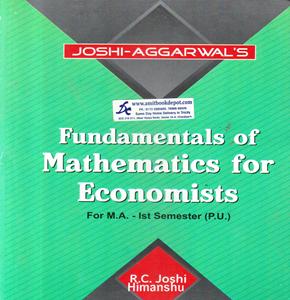
Yes, this book is meticulously crafted to cover 100% of the syllabus for Paper MAECO–103 (Quantitative Methods-I) for Semester I at PU Chandigarh, including all four units as per the latest structure.
Absolutely. The book's content is designed to comprehensively cover the syllabus for both "Mathematics for Economists - I" (16ECO21C4) in Semester I and "Mathematics for Economists - II" (16ECO22C4) in Semester II of MDU Rohtak.
Yes, it includes a dedicated chapter on Game Theory covering two-person zero-sum games, strategies, and solution methods, which is part of Unit IV for KU Kurukshetra.
Yes, it does. The book has detailed chapters on "Introduction to Input-Output Analysis" and "More on Matrices," which specifically cover Quadratic Forms, Eigen Roots (Eigenvalues), and Eigenvectors.
Yes, these are covered in dedicated chapters: "Growth Rate and Its Measurement" and "Present Value and Its Applications," which include estimation of simple, compound, and exponential growth rates.
Yes, the Linear Programming chapter covers the formulation and solution of the Dual problem from the Primal and explains the economic interpretation of the solution, including the concept of shadow prices.
Yes, the chapter on Differential Equations covers solutions for first-order equations (variable-separable, exact, linear) and linear second-order equations with constant coefficients and their economic applications.
Yes, the chapters on Matrices and Determinants cover the rank of a matrix, linear independence/dependence of vectors, and solutions of equations using both Matrix Inverse and Gauss Elimination methods.
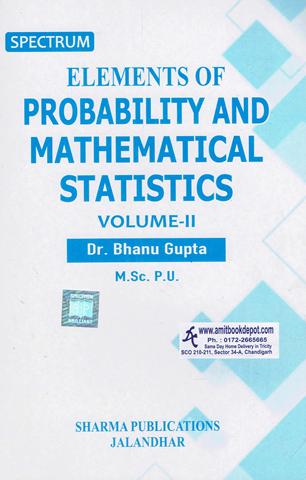
This particular volume focuses on the mathematical and deterministic quantitative methods. The statistical topics (Correlation, Regression, Time Series, Index Numbers, Probability Distributions, Inferences) for PU's MAECO-203 are typically covered in a separate companion book on Statistical Methods by the same publisher. Please check the title and description carefully.
Yes, the Linear Programming chapter breaks down the Simplex method into clear steps, illustrated with examples, covering formulation, feasible/basic/optimal solutions, and the simplex procedure.
No Description Added
Yes, this book is meticulously crafted to cover 100% of the syllabus for Paper MAECO–103 (Quantitative Methods-I) for Semester I at PU Chandigarh, including all four units as per the latest structure.
Absolutely. The book's content is designed to comprehensively cover the syllabus for both "Mathematics for Economists - I" (16ECO21C4) in Semester I and "Mathematics for Economists - II" (16ECO22C4) in Semester II of MDU Rohtak.
Yes, it includes a dedicated chapter on Game Theory covering two-person zero-sum games, strategies, and solution methods, which is part of Unit IV for KU Kurukshetra.
Yes, it does. The book has detailed chapters on "Introduction to Input-Output Analysis" and "More on Matrices," which specifically cover Quadratic Forms, Eigen Roots (Eigenvalues), and Eigenvectors.
Yes, these are covered in dedicated chapters: "Growth Rate and Its Measurement" and "Present Value and Its Applications," which include estimation of simple, compound, and exponential growth rates.
Yes, the Linear Programming chapter covers the formulation and solution of the Dual problem from the Primal and explains the economic interpretation of the solution, including the concept of shadow prices.
Yes, the chapter on Differential Equations covers solutions for first-order equations (variable-separable, exact, linear) and linear second-order equations with constant coefficients and their economic applications.
Yes, the chapters on Matrices and Determinants cover the rank of a matrix, linear independence/dependence of vectors, and solutions of equations using both Matrix Inverse and Gauss Elimination methods.
This particular volume focuses on the mathematical and deterministic quantitative methods. The statistical topics (Correlation, Regression, Time Series, Index Numbers, Probability Distributions, Inferences) for PU's MAECO-203 are typically covered in a separate companion book on Statistical Methods by the same publisher. Please check the title and description carefully.
Yes, the Linear Programming chapter breaks down the Simplex method into clear steps, illustrated with examples, covering formulation, feasible/basic/optimal solutions, and the simplex procedure.