-
Mon-Fri: 10AM to 8PM 01722665665
-
My Account
-
-
0
Total :
₹ 0.00

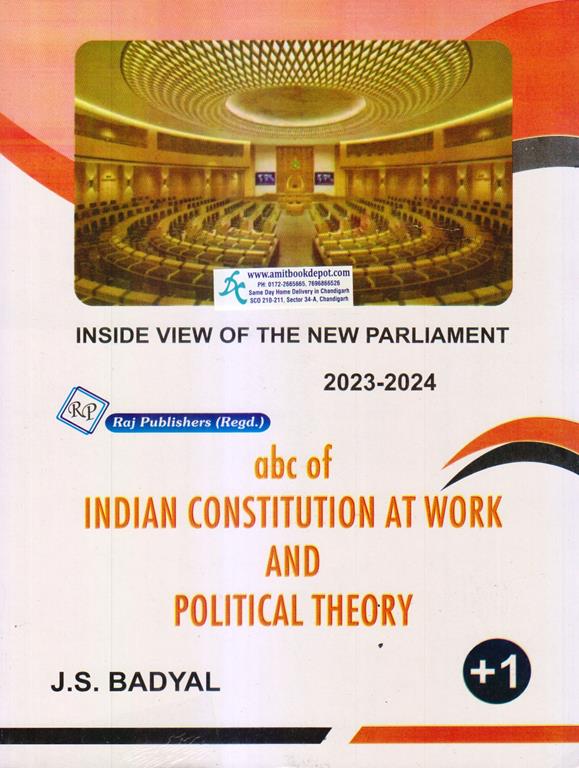
Raj Publishers' ABC of the Indian Constitution at Work and Political Theory (2026-2027 Edition) by J. S. Badyal is the definitive guide for Class 11 students. This textbook, published by Raj Publishers, systematically covers the entire CBSE syllabus in two clear parts. Part A explains the Indian Constitution at Work, including the union legislature, executive, judicial system, federalism, and local government (Panchayati Raj). Part B introduces political theory, covering liberty, equality, justice, nationalism, and secularism. Updated with the latest amendments and case studies, this book features exam-oriented Q&As, simplified definitions of judicial review, and thorough explanations of rights and duties. Ideal for scoring high marks, it bridges the gap between legal structure and political philosophy.




It aids and advises the President; real executive power is exercised by the Prime Minister and the council.
He is elected by an electoral college consisting of members of both Houses of Parliament through proportional representation.
Liberty implies absence of restraints with legal guarantees, while freedom is a broader concept of self-determination.
It evolves through amendments and judicial interpretations to adapt to changing social and political needs.
They remind citizens that enjoying rights comes with moral and civic obligations towards the nation.
To conduct free and fair elections by preparing electoral rolls, setting codes of conduct, and recognizing parties.
Review checks law validity; activism involves proactive interpretation to enforce rights, sometimes entering policymaking.
Guidelines for the government to create a welfare state; they are non-justiciable but fundamental to governance.
It performs detailed scrutiny of bills, budgets, and policies, saving time in the main house.
A shared sense of identity based on territory, culture, history, and the desire for political autonomy.
It aids and advises the President; real executive power is exercised by the Prime Minister and the council.
He is elected by an electoral college consisting of members of both Houses of Parliament through proportional representation.
Liberty implies absence of restraints with legal guarantees, while freedom is a broader concept of self-determination.
It evolves through amendments and judicial interpretations to adapt to changing social and political needs.
They remind citizens that enjoying rights comes with moral and civic obligations towards the nation.
To conduct free and fair elections by preparing electoral rolls, setting codes of conduct, and recognizing parties.
Review checks law validity; activism involves proactive interpretation to enforce rights, sometimes entering policymaking.
Guidelines for the government to create a welfare state; they are non-justiciable but fundamental to governance.
It performs detailed scrutiny of bills, budgets, and policies, saving time in the main house.
A shared sense of identity based on territory, culture, history, and the desire for political autonomy.