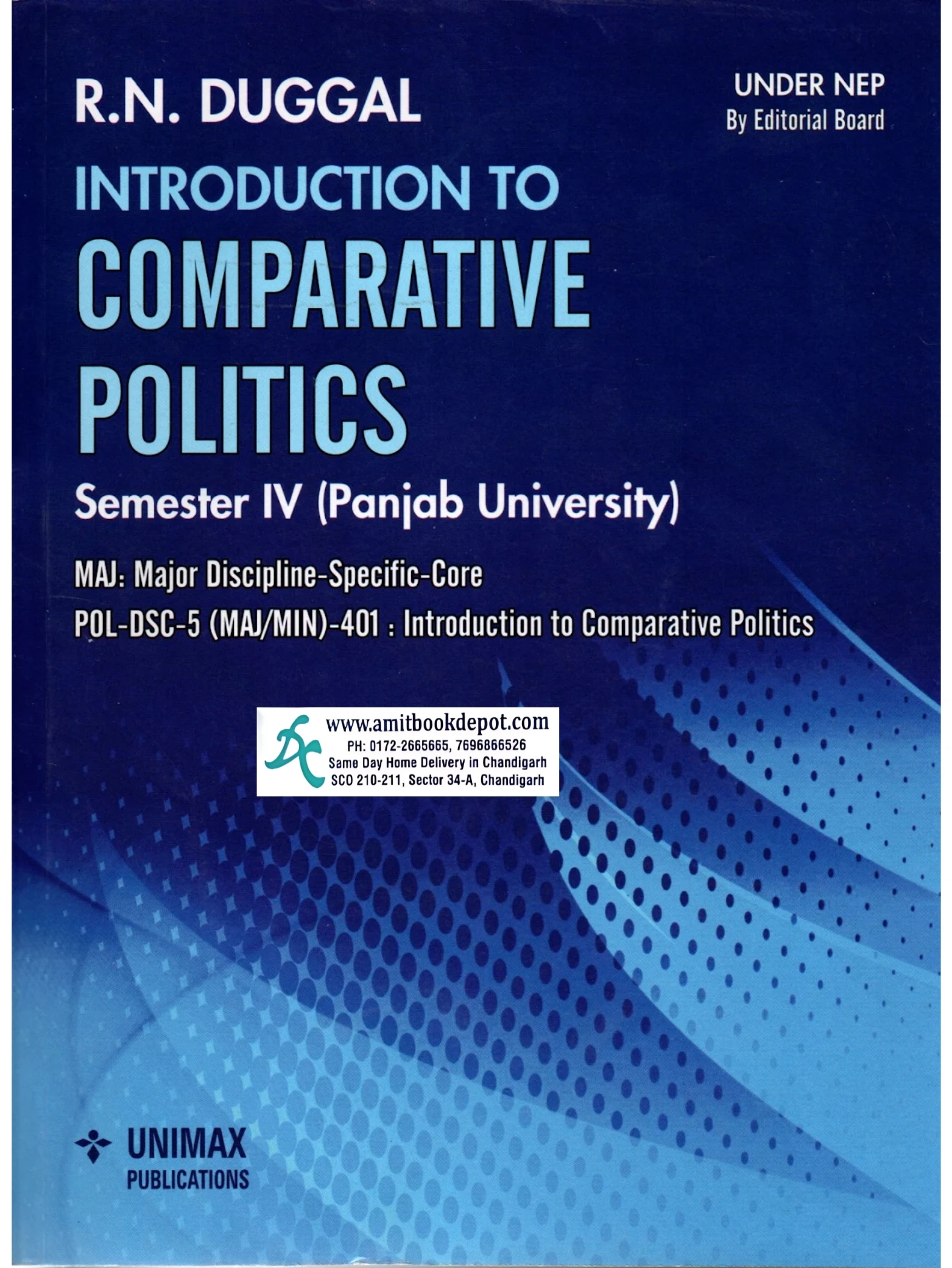
The book is authored by Rabinder Nath Duggal and published by Unimax Publications. It is specifically designed for Panjab University, Chandigarh students pursuing Political Science under the New Education Policy (NEP) 2020 curriculum.
This textbook covers course code HSS-POL-DSC5(MAJ/MIN)-401: Introduction to Comparative Politics. It is a 200-level discipline-specific core course offered to BA 4th Semester students as both Major and Minor subject under NEP.
The course carries 4 credits with total evaluation of 100 marks, comprising 80 marks for terminal theory examination and 20 marks for internal assessment. The internal assessment includes assignments, snap tests, attendance, and classroom participation.
The book is systematically divided into four comprehensive units: Unit I covers Understanding Comparative Politics as a Discipline, Unit II examines Political Systems, Unit III analyses Political Regimes, and Unit IV explores Political Parties and Pressure Groups.
The book provides detailed comparative analysis of the Parliamentary System through the United Kingdom case study and the Presidential System through the United States of America case study, examining their structures, functions, and operational dynamics.
Federal and Unitary systems are examined through comparative case studies of Canada as a federal system and the United Kingdom as a unitary system. The book analyses constitutional frameworks, division of powers, and operational characteristics of both systems.
Unit III comprehensively covers political regime classifications, types, and distinguishing features of Authoritarian and Democratic regimes. The chapters examine structural characteristics, operational mechanisms, and theoretical frameworks essential for comparative political analysis.
The textbook provides comprehensive coverage of meaning, characteristics, typologies, and functions of interest groups and pressure groups. Dedicated chapters examine their operational dynamics specifically within the United Kingdom and United States contexts.
The book promotes interdisciplinary insight, fosters independent and team-based learning, equips students to understand the scope and changing nature of Comparative Politics, and develops critical comparative methodology to analyse different political systems.
The book provides self-contained theoretical coverage enabling reappear/improvement candidates to prepare independently without classroom instruction. It aligns with the university provision where such candidates' theory marks are proportionately increased in lieu of internal assessment.
No Description Added
The book is authored by Rabinder Nath Duggal and published by Unimax Publications. It is specifically designed for Panjab University, Chandigarh students pursuing Political Science under the New Education Policy (NEP) 2020 curriculum.
This textbook covers course code HSS-POL-DSC5(MAJ/MIN)-401: Introduction to Comparative Politics. It is a 200-level discipline-specific core course offered to BA 4th Semester students as both Major and Minor subject under NEP.
The course carries 4 credits with total evaluation of 100 marks, comprising 80 marks for terminal theory examination and 20 marks for internal assessment. The internal assessment includes assignments, snap tests, attendance, and classroom participation.
The book is systematically divided into four comprehensive units: Unit I covers Understanding Comparative Politics as a Discipline, Unit II examines Political Systems, Unit III analyses Political Regimes, and Unit IV explores Political Parties and Pressure Groups.
The book provides detailed comparative analysis of the Parliamentary System through the United Kingdom case study and the Presidential System through the United States of America case study, examining their structures, functions, and operational dynamics.
Federal and Unitary systems are examined through comparative case studies of Canada as a federal system and the United Kingdom as a unitary system. The book analyses constitutional frameworks, division of powers, and operational characteristics of both systems.
Unit III comprehensively covers political regime classifications, types, and distinguishing features of Authoritarian and Democratic regimes. The chapters examine structural characteristics, operational mechanisms, and theoretical frameworks essential for comparative political analysis.
The textbook provides comprehensive coverage of meaning, characteristics, typologies, and functions of interest groups and pressure groups. Dedicated chapters examine their operational dynamics specifically within the United Kingdom and United States contexts.
The book promotes interdisciplinary insight, fosters independent and team-based learning, equips students to understand the scope and changing nature of Comparative Politics, and develops critical comparative methodology to analyse different political systems.
The book provides self-contained theoretical coverage enabling reappear/improvement candidates to prepare independently without classroom instruction. It aligns with the university provision where such candidates' theory marks are proportionately increased in lieu of internal assessment.