-
Mon-Fri: 10AM to 8PM 01722665665
-
My Account
-
-
0
Total :
₹ 0.00

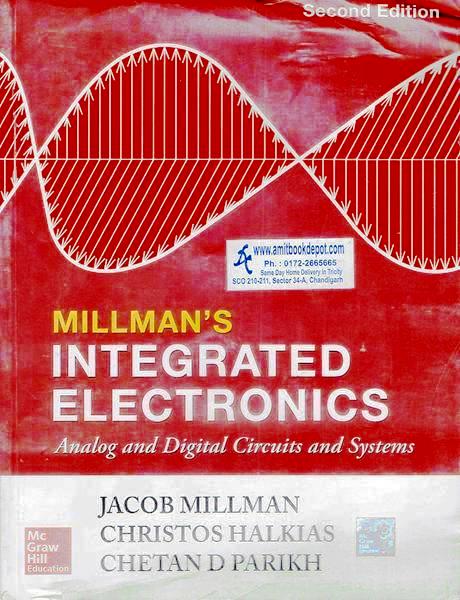

Chapter 1 explains energy bands in solids, differentiating conductors, insulators, and semiconductors – a prerequisite for understanding junction-diode and transistor characteristics.
Chapter 11 analyses transistor at high frequencies using hybrid-π model, Miller effect, and cut-off frequency, essential for wideband amplifier and oscillator design.
Chapter 7 details IC fabrication: epitaxy, photolithography, diffusion, and metallisation, linking semiconductor physics to monolithic circuit realisation.
Yes, Chapter 9 covers BJT biassing and thermal stabilisation; Chapter 10 separately addresses field-effect transistor biassing, load lines, and small-signal models.
Chapter 15 presents op-amp ideal characteristics, differential amplifier stages, offset voltages, and common-mode rejection before applications in analogue systems.
Chapter 16 covers active filters, instrumentation amplifiers, sample-and-hold circuits, and analogue multipliers using op-amps and discrete components.
Chapter 14 analyses Nyquist criterion, Barkhausen condition, and RC/LC oscillators – linking feedback amplifier theory to practical stable oscillator design.
Chapter 6 discusses logic gates, flip-flops, and switching characteristics of diodes and transistors, forming a base for digital ICs in Chapter 17.
Yes, Chapter 12 provides detailed analysis of RC-coupled, transformer-coupled, and direct-coupled multistage amplifiers with gain and bandwidth calculations.
Chapter 19 consolidates carrier transport, p-n junction physics, and breakdown mechanisms – serving as a reference for earlier device-characteristic chapters.
Chapter 1 explains energy bands in solids, differentiating conductors, insulators, and semiconductors – a prerequisite for understanding junction-diode and transistor characteristics.
Chapter 11 analyses transistor at high frequencies using hybrid-π model, Miller effect, and cut-off frequency, essential for wideband amplifier and oscillator design.
Chapter 7 details IC fabrication: epitaxy, photolithography, diffusion, and metallisation, linking semiconductor physics to monolithic circuit realisation.
Yes, Chapter 9 covers BJT biassing and thermal stabilisation; Chapter 10 separately addresses field-effect transistor biassing, load lines, and small-signal models.
Chapter 15 presents op-amp ideal characteristics, differential amplifier stages, offset voltages, and common-mode rejection before applications in analogue systems.
Chapter 16 covers active filters, instrumentation amplifiers, sample-and-hold circuits, and analogue multipliers using op-amps and discrete components.
Chapter 14 analyses Nyquist criterion, Barkhausen condition, and RC/LC oscillators – linking feedback amplifier theory to practical stable oscillator design.
Chapter 6 discusses logic gates, flip-flops, and switching characteristics of diodes and transistors, forming a base for digital ICs in Chapter 17.
Yes, Chapter 12 provides detailed analysis of RC-coupled, transformer-coupled, and direct-coupled multistage amplifiers with gain and bandwidth calculations.
Chapter 19 consolidates carrier transport, p-n junction physics, and breakdown mechanisms – serving as a reference for earlier device-characteristic chapters.