-
Mon-Fri: 10AM to 8PM 01722665665
-
My Account
-
-
0
Total :
₹ 0.00

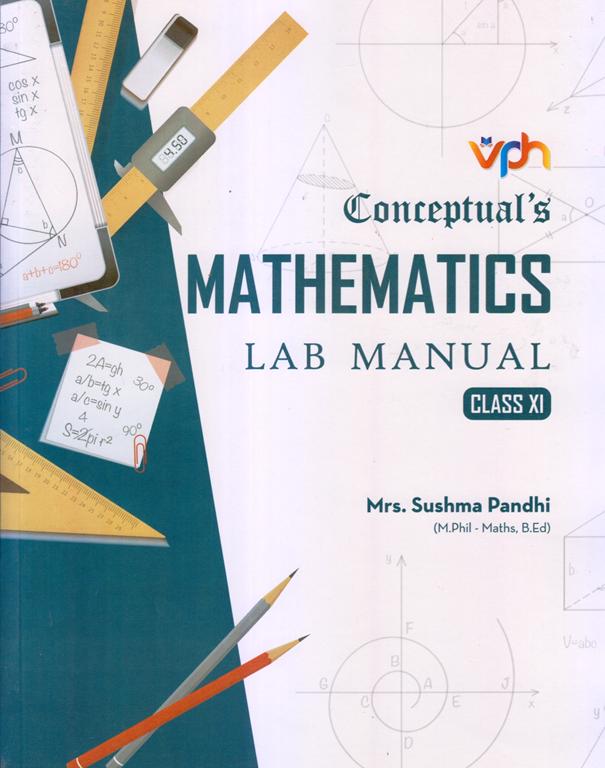
The Vohra Conceptual's Mathematics Lab Manual for Class 11, authored by Sushma Pandhi, is a comprehensive CBSE-aligned practical guide. It enables hands-on learning through activities covering sets, trigonometry, complex numbers, conic sections, calculus, and mathematical reasoning. Designed to complement the NCERT book, this manual helps students verify theories, plot graphs, construct models, and develop deep conceptual understanding. It is essential for practical file work, board exam preparation, and building a strong foundation for competitive exams like JEE. Published by Vohra Publishing House, it is the perfect resource for effective activity-based learning in Class 11 Mathematics.




Yes, the manual is meticulously crafted to align with the latest CBSE curriculum and the spirit of NEP 2020, covering all prescribed practical topics.
It is a comprehensive annual manual, containing 27 structured activities spanning all major units of the Class 11 syllabus, from Sets to Probability.
It provides a complete record of activities with clear steps, observation tables, and viva voce questions, serving as a ready reference for creating your practical file and preparing for the lab assessment.
Absolutely. The manual provides multiple, detailed methods (like the pinpoint and string method) for constructing accurate models of conic sections, which are often part of project work.
Yes, it uniquely uses simple electrical circuits with switches to visually and physically demonstrate the truth values of compound statements (p^q, pvq), linking abstract logic to a tangible application.
The manual guides students through the process and provides a framework for recording observations. The focus is on self-verification, but the methodology leads to the standard theoretical result.
Yes, most activities are written clearly enough for motivated students to perform at home with minimal guidance, making it an excellent tool for independent learning and exploration.
Yes, there are specific activities dedicated to plotting graphs of sin x, sin 2x, etc., on the same axes for comparison and shading the solution region for linear inequalities.
Yes, the manual includes innovative activities that guide students through a step-by-step process to visually or algebraically arrive at and verify such important formulas.
It includes an activity to explain the concept of octants using three mutually perpendicular planes (like a corner of a room), building a spatial understanding crucial for 3D geometry.
Yes, the manual is meticulously crafted to align with the latest CBSE curriculum and the spirit of NEP 2020, covering all prescribed practical topics.
It is a comprehensive annual manual, containing 27 structured activities spanning all major units of the Class 11 syllabus, from Sets to Probability.
It provides a complete record of activities with clear steps, observation tables, and viva voce questions, serving as a ready reference for creating your practical file and preparing for the lab assessment.
Absolutely. The manual provides multiple, detailed methods (like the pinpoint and string method) for constructing accurate models of conic sections, which are often part of project work.
Yes, it uniquely uses simple electrical circuits with switches to visually and physically demonstrate the truth values of compound statements (p^q, pvq), linking abstract logic to a tangible application.
The manual guides students through the process and provides a framework for recording observations. The focus is on self-verification, but the methodology leads to the standard theoretical result.
Yes, most activities are written clearly enough for motivated students to perform at home with minimal guidance, making it an excellent tool for independent learning and exploration.
Yes, there are specific activities dedicated to plotting graphs of sin x, sin 2x, etc., on the same axes for comparison and shading the solution region for linear inequalities.
Yes, the manual includes innovative activities that guide students through a step-by-step process to visually or algebraically arrive at and verify such important formulas.
It includes an activity to explain the concept of octants using three mutually perpendicular planes (like a corner of a room), building a spatial understanding crucial for 3D geometry.