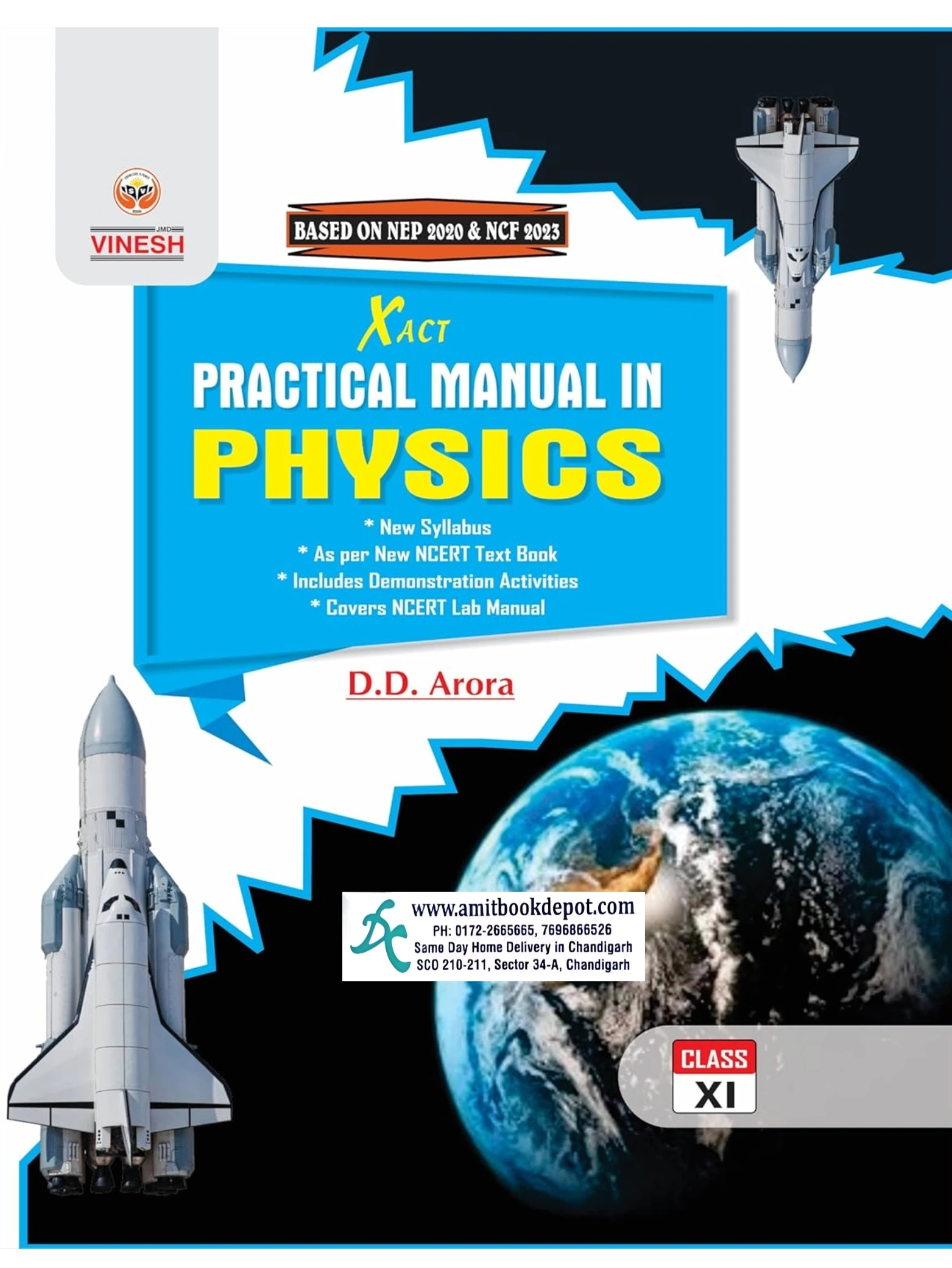
The Vinesh Xact Practical Manual in Physics for Class 11 by Dr. D. D. Sharma Arora is the definitive guide for the CBSE Physics Practical syllabus. This comprehensive manual provides detailed, step-by-step instructions for all required experiments and activities, divided into Section A and Section B. It covers essential techniques using Vernier calipers, screw gauges, and procedures for determining Young’s modulus, surface tension, and more. With clear theory, diagrams, procedures, observation tables, and viva questions, it is an essential resource for students to perform accurately in the lab, maintain a perfect record, and excel in their Class 11 Physics Practical Exam.
The Vinesh Xact Practical Manual in Physics for Class 11 by Dr. D. D. Sharma Arora, published by S. Dinesh & Co., is an indispensable and meticulously crafted laboratory companion for every Class 11 physics student. This Physics Practical Manual is designed to provide comprehensive, step-by-step guidance for successfully completing the CBSE Physics Practical syllabus prescribed by the Central Board of Secondary Education. It serves as a definitive guide for building a strong foundation in experimental physics and scientific methodology.
The manual is systematically structured into two core sections: Experiments and Activities, each further divided into Section A and Section B, perfectly aligning with the latest CBSE Class 11 practical syllabus. This structured approach ensures students cover all mandatory requirements efficiently. The Experiments Section covers a wide range of fundamental concepts, starting with precise measurement techniques using Vernier calipers and screw gauges for determining diameters, volumes, and thicknesses. It progresses to core principles like determining Young’s Modulus of Elasticity, verifying Boyle’s Law, finding the Coefficient of Viscosity, and calculating the Speed of Sound in Air using a resonance tube. Key mechanics experiments include verifying the Parallelogram Law of Vectors, studying limiting friction, and analyzing the motion of a simple pendulum through L-T² graphs.
Complementing the experiments, the Activities Section emphasizes application, conceptual understanding, and skill development. These include making a paper scale, applying the principle of moments, studying projectile motion, verifying the conservation of energy, and investigating phenomena like surface tension and cooling curves. These activities are crucial for developing analytical skills, learning graph plotting with error bars, and understanding real-world physics applications, which are vital for practical exam preparation and viva voce.
A standout feature of this Vinesh Xact Practical Manual is its commitment to clarity and exam-oriented preparation. Each experiment and activity is presented with a clear aim, a detailed apparatus listing, a well-labeled circuit diagram or setup illustration where needed, a precise theory, a logically sequenced procedure, guidelines for observations in tabular form, sample calculations, and a defined method for stating the result. It also includes essential precautions to minimize errors and a set of likely viva questions & answers to prepare students thoroughly for oral examinations. This format not only guides students in performing the practical correctly but also in maintaining a neat and complete Practical Record Notebook, which is a key component of the final assessment.
The manual simplifies complex concepts with lucid language and methodical instructions, making physics practical work accessible and less daunting. It emphasizes understanding over rote learning, encouraging students to grasp the underlying principles of each procedure. For educators, it is a reliable resource for structuring lab sessions, while for students, it is a self-sufficient guide for both school laboratory work and at-home revision.
Published by S. Dinesh & Co., a trusted name in academic publishing, this manual by Dr. D. D. Sharma Arora is renowned for its accuracy and educational value. It is more than just a lab book; it is a comprehensive tool that bridges the gap between theoretical knowledge and practical application, fostering scientific temper and precision. Investing in the Vinesh Xact Physics Practical Manual for Class 11 equips students with the confidence, skills, and knowledge to excel in their physics practical exams and build a robust foundation for competitive exams like NEET and JEE, where practical concepts are pivotal.
Is this manual updated for the latest CBSE Class 11 Physics Practical syllabus?
A1
Yes, the Vinesh Xact Practical Manual is strictly aligned with the latest CBSE Class 11 Physics Practical syllabus for the current academic session. It covers all prescribed experiments and activities in Section A and Section B as per board guidelines.
Q2
Are diagrams and graphs provided for better understanding?
A2
Yes, the manual includes clear labeled diagrams of experimental setups (e.g., vernier calipers, screw gauge, sonometer) and examples of graph plotting with proper scaling and error bars for relevant experiments.
Q3
Can this book help with viva voce preparation?
A3
Definitely. Each experiment concludes with a set of important viva questions and answers related to the procedure, theory, and concepts, helping students prepare thoroughly for practical viva voce examinations.
Q4
Does it cover activities in addition to experiments?
A4
Yes, the manual includes detailed instructions for both experiments and activities as per the CBSE syllabus. Activities focus on conceptual applications such as energy conservation, surface tension, and cooling curves.
Q5
Does it include real-life applications of experiments?
A5
Yes, where relevant, the manual highlights real-life applications of concepts—for example, bimetallic strips in thermostats, capillarity in plants, and Young’s modulus in construction materials.
Q6
Can this manual help in competitive exams like JEE/NEET?
A6
Yes, practical concepts from Class 11 Physics are foundational for JEE and NEET. The manual’s clear theory and application focus help strengthen conceptual understanding useful for objective-type questions.
Q7
Does it explain the use of lab instruments like vernier calipers and screw gauge in detail?
A7
Yes, initial experiments include detailed steps, diagrams, and reading methods for instruments like vernier calipers, screw gauge, spherometer, and beam balance to build foundational lab skills.
Q8
Is the manual useful for teachers for lab demonstration planning?
A8
Yes, teachers can use this manual as a structured reference for explaining procedures, demonstrations, and guiding students through accurate experiment execution and assessment.
Q9
Are numerical problems based on experiments included for practice?
A9
Yes, where applicable, the manual provides sample calculations and additional practice problems related to experiments to reinforce learning and calculation skills.
Q10
How is this manual different from other practical guides in the market?
A10
This manual stands out due to its strict syllabus alignment, exam-focused viva section, clear graphical representations, error analysis emphasis, and student-friendly language. It is published by S. Dinesh & Co. and authored by experienced academician Dr. D. D. Sharma Arora, ensuring reliability and pedagogical effectiveness.
0.00
0 Overall Rating
5
0
4
0
3
0
2
0
1
0
Try this product & share your review &
thoughts
EXPERIMENTS SECTION - A
Exp. 1. (a) To measure the diameter of a small spherical body using vernier calipers and hence calculate its volume.
(b) To measure the diameter and length of a small cylindrical body using vernier calipers and hence calculate its volume.
(c) To measure the internal diameter and depth of a given beaker/calorimeter using vernier calipers and hence find its volume.
Exp. 2. (a) To measure the diameter of a given wire using a screw gauge.
(b) To measure the thickness of a given sheet using a screw gauge.
Exp. 3. To determine the volume of an irregular lamina using a screw gauge.
Exp. 4. To determine the radius of curvature of a given spherical surface using a spherometer.
Exp. 5. To determine the mass of two different objects using a beam balance.
Exp. 6. To find the weight of a given body using the parallelogram law of vectors.
Exp. 7. Using a simple pendulum, plot the L-T² graph. Hence, find the effective length of a second’s pendulum.
Exp. 8. To study the variation of the time period of a simple pendulum of a given length by taking bobs of the same size but different masses and interpreting the result.
Exp. 9. To study the relationship between force of limiting friction and normal reaction and to find the coefficient of friction between a block and a horizontal surface.
Exp. 10. To find the downward force, along an inclined plane, acting on a roller due to the gravitational pull of the earth and study its relationship with the angle of inclination 0 by plotting a graph between force and sin 0.
EXPERIMENTS SECTION - B
Exp. 11. To determine Young’s modulus of elasticity of the material of a given wire.
Exp. 12. To find the force constant of a helical spring by plotting a graph between load and extension.
Exp. 13. To study the variation in volume with pressure for a sample of air at constant temperature by plotting graphs between P and V and between P and 1/V.
Or
To verify Boyle’s law.
Exp. 14. To determine the surface tension of water by the capillary rise method.
Exp. 15. To determine the coefficient of viscosity of a given viscous liquid by measuring the terminal velocity of a given spherical body.
Exp. 16. To study the relationship between the temperature of a hot body and time by plotting a cooling curve.
Exp. 17. To determine the specific heat capacity of a given solid by the method of mixtures.
Exp. 18. To study the relation between frequency and length of a given wire under constant tension using a sonometer.
Exp. 19. To study the relation between the length of a given wire and tension for constant frequency using a sonometer.
Exp. 20. To find the speed of sound in air at room temperature using a resonance tube by two resonance positions.
ACTIVITIES SECTION - A
Activity - 1. To make a paper scale of the given least count of (i) 0.2 cm (ii) 0.5 cm.
Activity - 2. To determine the mass of a given body using a meter scale by the principle of moments.
Activity - 3. To plot a graph for a given set of data, with proper choice of scales and error bars.
Activity - 4. To measure the force of limiting friction for rolling of a roller on a horizontal plane.
Activity - 5. To study the variation in range of a projectile with angle of projection.
Activity - 6.To study the conservation of energy of a ball rolling down on an inclined plane (using a double inclined plane).
Activity - 7. To study dissipation of energy of a simple pendulum by plotting a graph between square of amplitude and time.
ACTIVITIES SECTION - B
Activity - 8. To observe the change of state and plot a cooling curve for molten wax.
Activity - 9. To observe and explain the effect of heating on a bimetallic strip.
Activity—10. To note the change in level of liquid in a container on heating and interpret the observations.
Activity - 11. To study the effect of detergent on the surface tension of water by observing capillary rise.
Activity - 12. To study the factors affecting the rate of loss of heat of a liquid.
Activity - 13. To study the effect of load on depression of a suitably clamped meter scale loaded (i) at its end (ii) in the middle.
Activity - 14. To observe the decrease in pressure with the increase in velocity of a fluid.
LATEST SYLLABUS OF PHYSICS PRACTICALS - XI
PRACTICALS
The record to be submitted by the students at the time of their annual examination has to include:
* Record of at least 8 experiments [with 4 from each section], to be performed by the students.
* Record of at least 6 activities [with 3 each from section A and section B], to be performed by the students.
* Report of the project to be carried out by the students.
SECTION - A
Experiments
1. To measure the diameter of a small spherical body using vernier calipers and hence calculate its volume.
2. To measure the diameter of a given wire using a screw gauge.
3. To determine the volume of an irregular lamina using a screw gauge.
4. To determine the radius of curvature of a given spherical surface using a spherometer.
5. To determine the mass of two different objects using a beam balance.
6. To find the weight of a given body using the parallelogram law of vectors.
7. Using a simple pendulum, plot the L - T² graph. Hence, find the effective length of a second’s pendulum.
8. To study the variation of the time period of a simple pendulum of a given length by taking bobs of the same size but different masses and interpreting the result.
9. To study the relationship between the force of limiting friction and normal reaction and to find the coefficient of friction between a block and a horizontal surface.
10. To find the downward force, along an inclined plane, acting on a roller due to the gravitational pull of the earth and study its relationship with the angle of inclination 0 by plotting a graph between force and sin 0.
Activities
1. To make a paper scale of the given least count of (i) 0.2 cm (ii) 0.5 cm.
2. To determine the mass of a given body using a meter scale by the principle of moments.
3. To plot a graph for a given set of data, with proper choice of scales and error bars.
4. To measure the force of limiting friction for rolling of a roller on a horizontal plane.
5. To study the variation in range of a projectile with angle of projection.
6. To study the conservation of energy of a ball rolling down on an inclined plane (using a double inclined plane).
7. To study dissipation of energy of a simple pendulum by plotting a graph between square of amplitude and time.
SECTION - B
Experiments
1. To determine Young’s modulus of elasticity of the material of a given wire.
2. To find the force constant of a helical spring by plotting a graph between load and extension.
3. To study the variation in volume with pressure for a sample of air at constant temperature by plotting graphs between P and V and between P and 1/V.
4. To determine the surface tension of water by the capillary rise method.
5. To determine the coefficient of viscosity of a given viscous liquid by measuring the terminal velocity of a given spherical body.
6. To study the relationship between the temperature of a hot body and time by plotting a cooling curve.
7. To determine the specific heat capacity of a given solid by the method of mixtures.
8. To study the relation between frequency and length of a given wire under constant tension using a sonometer.
9. To study the relation between the length of a given wire and tension for constant frequency using a sonometer.
10. To find the speed of sound in air at room temperature using a resonance tube by two resonance positions.
Activities
1. To observe change of state and plot a cooling curve for molten wax.
2. To observe and explain the effect of heating on a bimetallic strip.
3. To note the change in level of liquid in a container on heating and interpret the observations.
4. To study the effect of detergent on the surface tension of water by observing capillary rise.
5. To study the factors affecting the rate of loss of heat of a liquid.
6. To study the effect of load on depression of a suitably clamped meter scale loaded (i) at its end (ii) in the middle.
7. To observe the decrease in pressure with the increase in velocity of a fluid.
The Vinesh Xact Practical Manual in Physics for Class 11 by Dr. D. D. Sharma Arora, published by S. Dinesh & Co., is an indispensable and meticulously crafted laboratory companion for every Class 11 physics student. This Physics Practical Manual is designed to provide comprehensive, step-by-step guidance for successfully completing the CBSE Physics Practical syllabus prescribed by the Central Board of Secondary Education. It serves as a definitive guide for building a strong foundation in experimental physics and scientific methodology.
The manual is systematically structured into two core sections: Experiments and Activities, each further divided into Section A and Section B, perfectly aligning with the latest CBSE Class 11 practical syllabus. This structured approach ensures students cover all mandatory requirements efficiently. The Experiments Section covers a wide range of fundamental concepts, starting with precise measurement techniques using Vernier calipers and screw gauges for determining diameters, volumes, and thicknesses. It progresses to core principles like determining Young’s Modulus of Elasticity, verifying Boyle’s Law, finding the Coefficient of Viscosity, and calculating the Speed of Sound in Air using a resonance tube. Key mechanics experiments include verifying the Parallelogram Law of Vectors, studying limiting friction, and analyzing the motion of a simple pendulum through L-T² graphs.
Complementing the experiments, the Activities Section emphasizes application, conceptual understanding, and skill development. These include making a paper scale, applying the principle of moments, studying projectile motion, verifying the conservation of energy, and investigating phenomena like surface tension and cooling curves. These activities are crucial for developing analytical skills, learning graph plotting with error bars, and understanding real-world physics applications, which are vital for practical exam preparation and viva voce.
A standout feature of this Vinesh Xact Practical Manual is its commitment to clarity and exam-oriented preparation. Each experiment and activity is presented with a clear aim, a detailed apparatus listing, a well-labeled circuit diagram or setup illustration where needed, a precise theory, a logically sequenced procedure, guidelines for observations in tabular form, sample calculations, and a defined method for stating the result. It also includes essential precautions to minimize errors and a set of likely viva questions & answers to prepare students thoroughly for oral examinations. This format not only guides students in performing the practical correctly but also in maintaining a neat and complete Practical Record Notebook, which is a key component of the final assessment.
The manual simplifies complex concepts with lucid language and methodical instructions, making physics practical work accessible and less daunting. It emphasizes understanding over rote learning, encouraging students to grasp the underlying principles of each procedure. For educators, it is a reliable resource for structuring lab sessions, while for students, it is a self-sufficient guide for both school laboratory work and at-home revision.
Published by S. Dinesh & Co., a trusted name in academic publishing, this manual by Dr. D. D. Sharma Arora is renowned for its accuracy and educational value. It is more than just a lab book; it is a comprehensive tool that bridges the gap between theoretical knowledge and practical application, fostering scientific temper and precision. Investing in the Vinesh Xact Physics Practical Manual for Class 11 equips students with the confidence, skills, and knowledge to excel in their physics practical exams and build a robust foundation for competitive exams like NEET and JEE, where practical concepts are pivotal.
EXPERIMENTS SECTION - A
Exp. 1. (a) To measure the diameter of a small spherical body using vernier calipers and hence calculate its volume.
(b) To measure the diameter and length of a small cylindrical body using vernier calipers and hence calculate its volume.
(c) To measure the internal diameter and depth of a given beaker/calorimeter using vernier calipers and hence find its volume.
Exp. 2. (a) To measure the diameter of a given wire using a screw gauge.
(b) To measure the thickness of a given sheet using a screw gauge.
Exp. 3. To determine the volume of an irregular lamina using a screw gauge.
Exp. 4. To determine the radius of curvature of a given spherical surface using a spherometer.
Exp. 5. To determine the mass of two different objects using a beam balance.
Exp. 6. To find the weight of a given body using the parallelogram law of vectors.
Exp. 7. Using a simple pendulum, plot the L-T² graph. Hence, find the effective length of a second’s pendulum.
Exp. 8. To study the variation of the time period of a simple pendulum of a given length by taking bobs of the same size but different masses and interpreting the result.
Exp. 9. To study the relationship between force of limiting friction and normal reaction and to find the coefficient of friction between a block and a horizontal surface.
Exp. 10. To find the downward force, along an inclined plane, acting on a roller due to the gravitational pull of the earth and study its relationship with the angle of inclination 0 by plotting a graph between force and sin 0.
EXPERIMENTS SECTION - B
Exp. 11. To determine Young’s modulus of elasticity of the material of a given wire.
Exp. 12. To find the force constant of a helical spring by plotting a graph between load and extension.
Exp. 13. To study the variation in volume with pressure for a sample of air at constant temperature by plotting graphs between P and V and between P and 1/V.
Or
To verify Boyle’s law.
Exp. 14. To determine the surface tension of water by the capillary rise method.
Exp. 15. To determine the coefficient of viscosity of a given viscous liquid by measuring the terminal velocity of a given spherical body.
Exp. 16. To study the relationship between the temperature of a hot body and time by plotting a cooling curve.
Exp. 17. To determine the specific heat capacity of a given solid by the method of mixtures.
Exp. 18. To study the relation between frequency and length of a given wire under constant tension using a sonometer.
Exp. 19. To study the relation between the length of a given wire and tension for constant frequency using a sonometer.
Exp. 20. To find the speed of sound in air at room temperature using a resonance tube by two resonance positions.
ACTIVITIES SECTION - A
Activity - 1. To make a paper scale of the given least count of (i) 0.2 cm (ii) 0.5 cm.
Activity - 2. To determine the mass of a given body using a meter scale by the principle of moments.
Activity - 3. To plot a graph for a given set of data, with proper choice of scales and error bars.
Activity - 4. To measure the force of limiting friction for rolling of a roller on a horizontal plane.
Activity - 5. To study the variation in range of a projectile with angle of projection.
Activity - 6.To study the conservation of energy of a ball rolling down on an inclined plane (using a double inclined plane).
Activity - 7. To study dissipation of energy of a simple pendulum by plotting a graph between square of amplitude and time.
ACTIVITIES SECTION - B
Activity - 8. To observe the change of state and plot a cooling curve for molten wax.
Activity - 9. To observe and explain the effect of heating on a bimetallic strip.
Activity—10. To note the change in level of liquid in a container on heating and interpret the observations.
Activity - 11. To study the effect of detergent on the surface tension of water by observing capillary rise.
Activity - 12. To study the factors affecting the rate of loss of heat of a liquid.
Activity - 13. To study the effect of load on depression of a suitably clamped meter scale loaded (i) at its end (ii) in the middle.
Activity - 14. To observe the decrease in pressure with the increase in velocity of a fluid.
Is this manual updated for the latest CBSE Class 11 Physics Practical syllabus?
A1
Yes, the Vinesh Xact Practical Manual is strictly aligned with the latest CBSE Class 11 Physics Practical syllabus for the current academic session. It covers all prescribed experiments and activities in Section A and Section B as per board guidelines.
Q2
Are diagrams and graphs provided for better understanding?
A2
Yes, the manual includes clear labeled diagrams of experimental setups (e.g., vernier calipers, screw gauge, sonometer) and examples of graph plotting with proper scaling and error bars for relevant experiments.
Q3
Can this book help with viva voce preparation?
A3
Definitely. Each experiment concludes with a set of important viva questions and answers related to the procedure, theory, and concepts, helping students prepare thoroughly for practical viva voce examinations.
Q4
Does it cover activities in addition to experiments?
A4
Yes, the manual includes detailed instructions for both experiments and activities as per the CBSE syllabus. Activities focus on conceptual applications such as energy conservation, surface tension, and cooling curves.
Q5
Does it include real-life applications of experiments?
A5
Yes, where relevant, the manual highlights real-life applications of concepts—for example, bimetallic strips in thermostats, capillarity in plants, and Young’s modulus in construction materials.
Q6
Can this manual help in competitive exams like JEE/NEET?
A6
Yes, practical concepts from Class 11 Physics are foundational for JEE and NEET. The manual’s clear theory and application focus help strengthen conceptual understanding useful for objective-type questions.
Q7
Does it explain the use of lab instruments like vernier calipers and screw gauge in detail?
A7
Yes, initial experiments include detailed steps, diagrams, and reading methods for instruments like vernier calipers, screw gauge, spherometer, and beam balance to build foundational lab skills.
Q8
Is the manual useful for teachers for lab demonstration planning?
A8
Yes, teachers can use this manual as a structured reference for explaining procedures, demonstrations, and guiding students through accurate experiment execution and assessment.
Q9
Are numerical problems based on experiments included for practice?
A9
Yes, where applicable, the manual provides sample calculations and additional practice problems related to experiments to reinforce learning and calculation skills.
Q10
How is this manual different from other practical guides in the market?
A10
This manual stands out due to its strict syllabus alignment, exam-focused viva section, clear graphical representations, error analysis emphasis, and student-friendly language. It is published by S. Dinesh & Co. and authored by experienced academician Dr. D. D. Sharma Arora, ensuring reliability and pedagogical effectiveness.
LATEST SYLLABUS OF PHYSICS PRACTICALS - XI
PRACTICALS
The record to be submitted by the students at the time of their annual examination has to include:
* Record of at least 8 experiments [with 4 from each section], to be performed by the students.
* Record of at least 6 activities [with 3 each from section A and section B], to be performed by the students.
* Report of the project to be carried out by the students.
SECTION - A
Experiments
1. To measure the diameter of a small spherical body using vernier calipers and hence calculate its volume.
2. To measure the diameter of a given wire using a screw gauge.
3. To determine the volume of an irregular lamina using a screw gauge.
4. To determine the radius of curvature of a given spherical surface using a spherometer.
5. To determine the mass of two different objects using a beam balance.
6. To find the weight of a given body using the parallelogram law of vectors.
7. Using a simple pendulum, plot the L - T² graph. Hence, find the effective length of a second’s pendulum.
8. To study the variation of the time period of a simple pendulum of a given length by taking bobs of the same size but different masses and interpreting the result.
9. To study the relationship between the force of limiting friction and normal reaction and to find the coefficient of friction between a block and a horizontal surface.
10. To find the downward force, along an inclined plane, acting on a roller due to the gravitational pull of the earth and study its relationship with the angle of inclination 0 by plotting a graph between force and sin 0.
Activities
1. To make a paper scale of the given least count of (i) 0.2 cm (ii) 0.5 cm.
2. To determine the mass of a given body using a meter scale by the principle of moments.
3. To plot a graph for a given set of data, with proper choice of scales and error bars.
4. To measure the force of limiting friction for rolling of a roller on a horizontal plane.
5. To study the variation in range of a projectile with angle of projection.
6. To study the conservation of energy of a ball rolling down on an inclined plane (using a double inclined plane).
7. To study dissipation of energy of a simple pendulum by plotting a graph between square of amplitude and time.
SECTION - B
Experiments
1. To determine Young’s modulus of elasticity of the material of a given wire.
2. To find the force constant of a helical spring by plotting a graph between load and extension.
3. To study the variation in volume with pressure for a sample of air at constant temperature by plotting graphs between P and V and between P and 1/V.
4. To determine the surface tension of water by the capillary rise method.
5. To determine the coefficient of viscosity of a given viscous liquid by measuring the terminal velocity of a given spherical body.
6. To study the relationship between the temperature of a hot body and time by plotting a cooling curve.
7. To determine the specific heat capacity of a given solid by the method of mixtures.
8. To study the relation between frequency and length of a given wire under constant tension using a sonometer.
9. To study the relation between the length of a given wire and tension for constant frequency using a sonometer.
10. To find the speed of sound in air at room temperature using a resonance tube by two resonance positions.
Activities
1. To observe change of state and plot a cooling curve for molten wax.
2. To observe and explain the effect of heating on a bimetallic strip.
3. To note the change in level of liquid in a container on heating and interpret the observations.
4. To study the effect of detergent on the surface tension of water by observing capillary rise.
5. To study the factors affecting the rate of loss of heat of a liquid.
6. To study the effect of load on depression of a suitably clamped meter scale loaded (i) at its end (ii) in the middle.
7. To observe the decrease in pressure with the increase in velocity of a fluid.
0.00
0 Overall Rating
5
0
4
0
3
0
2
0
1
0
Try this product & share your review &
thoughts
Top Trending Product
Related
Product
Related Product
Related Blog Posts
Latest Blogs
Latest Blogs
Classic Literature Reimagined: Discuss modern twists on classic novels.
Lorem ipsum dolor sit amet, consectetur adipiscing elit, sed
do
eiusmod tempor incididunt ut labore et dolore magna aliqua. Ut enim ad minim
veniam, quis nostrud exercitation ullamco Lorem ipsum dolor sit amet,
consectetur adipiscing elit, sed do eiusmod tempor incididunt ut labore et
dolore magna aliqua. Utenim ad minim veniam, quis nostrud exercitation
ullamco
Lorem ipsum dolor sit amet, consecte...
Classic Literature Reimagined: Discuss modern twists on classic novels.
Lorem ipsum dolor sit amet, consectetur adipiscing elit, sed
do
eiusmod tempor incididunt ut labore et dolore magna aliqua. Ut enim ad minim
veniam, quis nostrud exercitation ullamco Lorem ipsum dolor sit amet,
consectetur adipiscing elit, sed do eiusmod tempor incididunt ut labore et
dolore magna aliqua. Utenim ad minim veniam, quis nostrud exercitation
ullamco
Lorem ipsum dolor sit amet, consecte...
Classic Literature Reimagined: Discuss modern twists on classic novels.
Lorem ipsum dolor sit amet, consectetur adipiscing elit, sed
do
eiusmod tempor incididunt ut labore et dolore magna aliqua. Ut enim ad minim
veniam, quis nostrud exercitation ullamco Lorem ipsum dolor sit amet,
consectetur adipiscing elit, sed do eiusmod tempor incididunt ut labore et
dolore magna aliqua. Utenim ad minim veniam, quis nostrud exercitation
ullamco
Lorem ipsum dolor sit amet, consecte...