-
Mon-Fri: 10AM to 8PM 01722665665
-
My Account
-
-
0
Total :
₹ 0.00

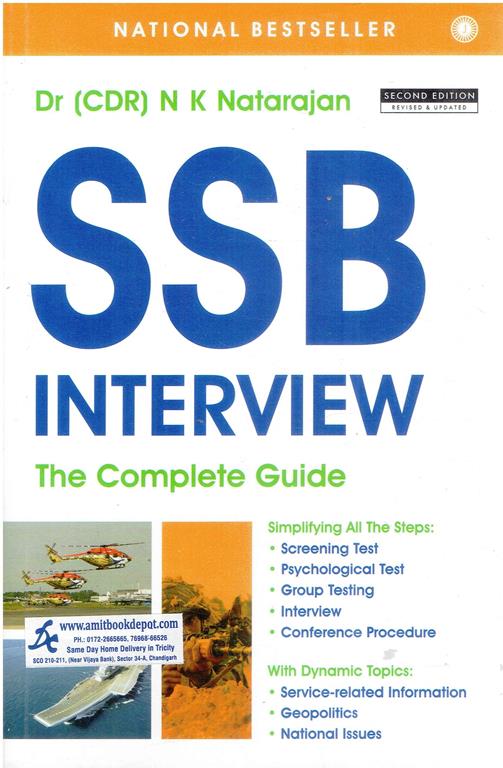
SSB Interview: The Complete Guide by Dr N K Natarajan is the definitive preparation resource for SSB aspirants. This comprehensive guide simplifies every stage, including screening tests, psychological testing, group testing, interviews, and conference procedures. Authored by a former Indian Navy Group Testing Officer with 25 years of experience, the book covers the Thematic Apperception Test (TAT), Word Association Test (WAT), Situation Reaction Test (SRT), Group Discussion, Lecturette, and all Group Testing Officer tasks. The updated edition includes service-related information, geopolitics, national issues, and current affairs. An essential training kit for defence aspirants targeting NDA, CDS, AFCAT, and other service entries.
Officer Like Qualities (OLQ) form the foundation of SSB assessment. These include effective intelligence, reasoning ability, power of expression, social adaptability, and leadership potential .
Screening comprises Verbal and Non-Verbal Intelligence Tests followed by the Picture Perception and Discussion Test (PP&DT). Candidates who pass proceed to Day 2 of the selection process .
The psychological battery includes Thematic Apperception Test (TAT), Word Association Test (WAT), Situation Reaction Test (SRT), and Self-Description Test (SDT), assessing subconscious personality traits .
Lecturette is an individual presentation on a given topic for 3-4 minutes, testing communication skills, subject knowledge, and confidence, unlike GD which focuses on group interaction .
The PIQ forms the basis for the personal interview, containing details about the candidate's background, education, achievements, and family history. It must be filled accurately .
Key topics include GST, Demonetisation, Smart Cities Mission, Swachh Bharat Abhiyan, Triple Talaq, Rafale Deal, NRC, Defence Budget, BrahMos Missiles, and India-China relations .
TAT requires candidates to write stories based on ambiguous pictures. Focus on positive themes, proactive protagonists, and logical narratives that demonstrate leadership qualities .
Important topics include Indo-Pak Relations, Indo-China Relations, Indo-US Nuclear Deal, NPT, NATO, UNSC reforms, Israel-Palestine conflict, and India's neighbourhood policies .
GPE presents a map-based problem requiring candidates to plan solutions collectively, demonstrating planning ability, practical intelligence, and group coordination skills .
Individual Obstacles test physical courage, determination, and confidence through 10 obstacles. Practice and mental preparation are crucial for performing under observation .
Officer Like Qualities (OLQ) form the foundation of SSB assessment. These include effective intelligence, reasoning ability, power of expression, social adaptability, and leadership potential .
Screening comprises Verbal and Non-Verbal Intelligence Tests followed by the Picture Perception and Discussion Test (PP&DT). Candidates who pass proceed to Day 2 of the selection process .
The psychological battery includes Thematic Apperception Test (TAT), Word Association Test (WAT), Situation Reaction Test (SRT), and Self-Description Test (SDT), assessing subconscious personality traits .
Lecturette is an individual presentation on a given topic for 3-4 minutes, testing communication skills, subject knowledge, and confidence, unlike GD which focuses on group interaction .
The PIQ forms the basis for the personal interview, containing details about the candidate's background, education, achievements, and family history. It must be filled accurately .
Key topics include GST, Demonetisation, Smart Cities Mission, Swachh Bharat Abhiyan, Triple Talaq, Rafale Deal, NRC, Defence Budget, BrahMos Missiles, and India-China relations .
TAT requires candidates to write stories based on ambiguous pictures. Focus on positive themes, proactive protagonists, and logical narratives that demonstrate leadership qualities .
Important topics include Indo-Pak Relations, Indo-China Relations, Indo-US Nuclear Deal, NPT, NATO, UNSC reforms, Israel-Palestine conflict, and India's neighbourhood policies .
GPE presents a map-based problem requiring candidates to plan solutions collectively, demonstrating planning ability, practical intelligence, and group coordination skills .
Individual Obstacles test physical courage, determination, and confidence through 10 obstacles. Practice and mental preparation are crucial for performing under observation .