Categories
College Bookssss >
BA PU Chandigarh
BSC PU Chandigarh
MSC PU Chandigarh
BBA PU Chandigarh
MA PU Chandigarh
Medical Books
Engineering Books
Management Books
PGDCA Books
BCOM PU Chandigarh
MCOM PU Chandigarh
BCA PU Chandigarh
MCA PU Chandigarh
animate-books

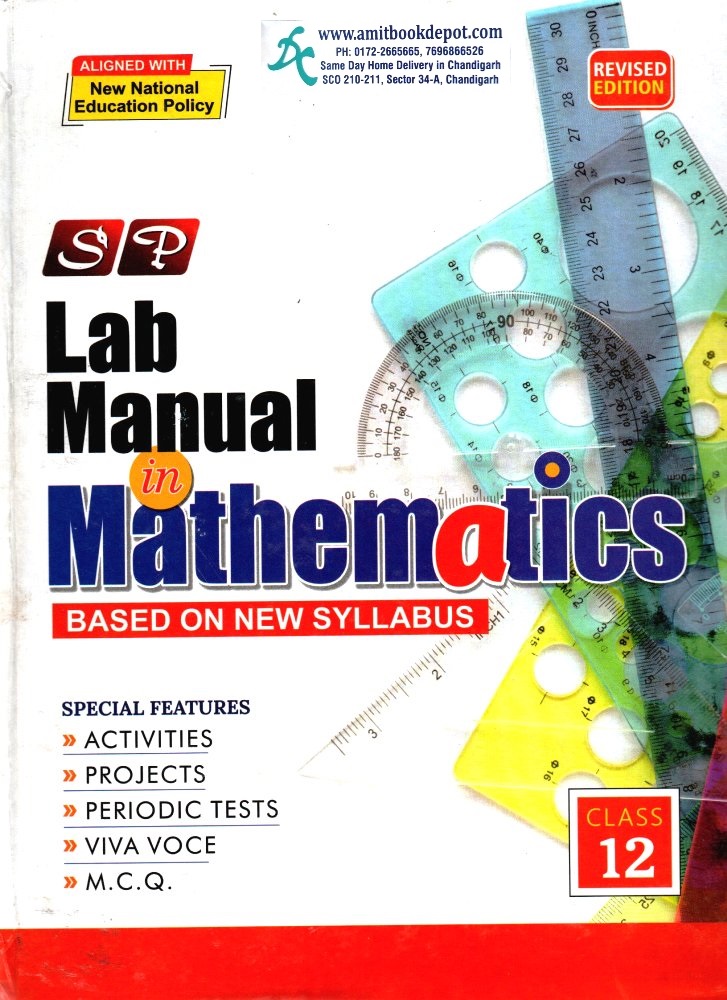
SP Laboratory Manual Mathematics for Class 12th

by Madhurima
₹425 ₹425.00(-/ off)

Rating & Reviews

23 Customer Review

The SP Laboratory Manual Mathematics for Class 12th by SP Books is a complete practical companion for CBSE students. Covering 22 hands-on activities, this manual verifies key topics including relations, one-to-one and onto functions, graphs of sin⁻¹ x, limits, continuity, increasing/decreasing functions, maxima/minima, and optimisation problems like maximising box volume. Vector algebra activities verify cross-product properties and angle in a semicircle, while 3D geometry and conditional probability exercises strengthen analytical skills. Aligned with NCERT project work and periodic tests, this manual ensures thorough preparation for CBSE practical exams. Essential keywords: Class 12 Maths Lab Manual, SP Books, CBSE practical notebook, NCERT mathematics activities, calculus lab, vector verification, probability experiment.

Have Doubts Regarding This Product ? Ask Your Question

  • Q1
    Which property is verified using lines in a plane where R = {(l, m): l ⟂ m}?
    A1

    Symmetric but neither reflexive nor transitive. Perpendicularity is symmetric, but a line is not perpendicular to itself nor transitive.

  • Q2
    Name the activity that proves a function can be onto but not one-one.
    A2

    Activity 3 demonstrates a function which is not one-to-one but is onto, using appropriate mapping examples.

  • Q3
    How is the graph of sin⁻¹ x obtained from sin x?
    A3

    By mirror reflection about line y = x using the concept of inverse functions and principal value branch.

  • Q4
    Which activity establishes a relationship between common and natural logarithm?
    A4

    Activity 8 finds relationship between log₁₀ x and logₑ x, linking base conversion and natural log.

  • Q5
    How is continuity verified at a point x₀?
    A5

    Activity 10 shows Δy = f(x₀ + Δx) – f(x₀) becomes arbitrarily small when Δx is sufficiently small.

  • Q6
    Name the activity verifying square has maximum area among rectangles of same perimeter.
    A6

    Activity 16 verifies that for fixed perimeter, square gives maximum area using derivative or geometric reasoning.

  • Q7
    Which activity proves angle in a semicircle is a right angle?
    A7

    Activity 19 uses vector method to show that angle subtended by diameter at circumference is 90°.

  • Q8
    Which activity explains conditional probability P(A|B) with dice?
    A8

    Activity 22 uses throwing a pair of dice to compute conditional probability when event B has already occurred.

  • Q9
    Which activity demonstrates a one-one but not onto function?
    A9

    Activity 4 demonstrates a function that is injective but not surjective using suitable domain and codomain.

  • Q10
    Which two functions are mirror images of each other in Activity 7?
    A10

    Graphs of aˣ and logₐ x (a > 0) are mirror images about line y = x for exponential and logarithmic functions.

0.00

0 Overall Rating
  • 5
    0
  • 4
    0
  • 3
    0
  • 2
    0
  • 1
    0

Try this product & share your review & thoughts

ACTIVITIES

1. To verify that the relation R in the set L of all lines in a plane, defined by R = ((l, m): 11m), is symmetric but neither reflexive nor transitive.
2. To verify that the relation R in the set L of all lines in a plane, defined by R = (l, m): l || m, is an equivalence relation.
3. To demonstrate a function which is not one-to-one but is onto.
4. To demonstrate a function which is one-one but not onto,
5. To draw the graph of sin⁻¹ x, using the graph of sin x, and demonstrate the concept of mirror reflection (about the line y = x).
6. To explore the principal value of the function sin⁻¹ x using a unit circle.
7. To sketch the graphs of axe and logₐ x, a > 0, and to examine that they are mirror images of each other.
8. To establish a relationship between common logarithm (to the base 10) and natural logarithm (to the base e) of the number x,
9. To find analytically the limit of a function f (x) at x = c and also to check the continuity of the function at that point.
10. To verify that for a function to be continuous at a given point x₀, Ay = f (x₀ + Ar) - (x₀) is arbitrarily small provided Axe is sufficiently small.
11. To understand the concepts of decreasing and increasing functions.
12. To understand the concepts of local maxima, local minima and points of inflection.
13. To understand the concepts of absolute maximum and minimum values of a function in a given closed interval through its graph.
14. To construct an open box of maximum volume from a given rectangular sheet by cutting equal squares from each corner.
15. To find the time when the area of a rectangle of given dimensions becomes maximum if its length is decreasing and the breadth is increasing at given rates.
16. To verify that amongst all the rectangles of the same perimeter, the square has the maximum area.
17. To evaluate the definite integral (1-x) actual integration. dx as the limit of a sum and verify it by
18. To verify geometrically that cx(a+b)=cxa+cxb
19. To verify that an angle in a semicircle is a right angle, using the vector method.
20. To locate the points to given coordinates in space, measure the distance between two points in space and then verify the distance using the distance formula.
21. To measure the shortest distance between two skew lines and verify it analytically.
22. To explain the computation of the conditional probability of a given event A when event B has already occurred through an example of throwing a pair of dice.

Projects as suggested by N.C.E.R.T.
Periodic Test

SP Laboratory Manual Mathematics for Class 12th – A Comprehensive Hands-On Guide for CBSE Practical Exams

Developed by SP Books, this SP Laboratory Manual Mathematics for Class 12 is an essential resource for students aiming to master the practical and activity-based components of the CBSE Class 12 Mathematics curriculum. Aligned with the latest CBSE syllabus and NCERT guidelines, this manual bridges the gap between theoretical concepts and their verifiable applications through structured activities and projects.

The book systematically covers 22 core activities that help students verify critical mathematical principles. Starting with foundational topics in relations and functions, activities include verifying symmetric, reflexive, and transitive properties using lines in a plane, as well as demonstrating one-one and onto functions. Graphical concepts are emphasised through exercises such as drawing the graph of sin⁻¹ x using mirror reflection of the graph of sin x about the line y = x and sketching exponential and logarithmic functions as mirror images.

In calculus, the manual guides learners to analytically find limits, check continuity at a point, and understand increasing/decreasing functions. Practical optimisation problems are covered through activities like constructing an open box of maximum volume from a rectangular sheet and verifying that a square has the maximum area among rectangles of the same perimeter. Definite integrals are evaluated as limits of sums, and geometrical verification of vector properties—such as cross-product distributivity and angle in a semicircle using the vector method—is clearly demonstrated.

Additional activities include measuring the shortest distance between two skew lines, verifying the distance formula in 3D space, and computing conditional probability using dice-rolling experiments. Projects as suggested by NCERT and periodic tests are also included to ensure exam readiness.

This mathematics lab manual for Class 12 is ideal for CBSE practical exam preparation, internal assessment, and viva voce. Keywords: CBSE Class 12 Maths Lab Manual, SP Books, NCERT activities, relations and functions, inverse trigonometric graphs, limits and continuity, maxima and minima, vector algebra, conditional probability, practical mathematics.

ACTIVITIES

1. To verify that the relation R in the set L of all lines in a plane, defined by R = ((l, m): 11m), is symmetric but neither reflexive nor transitive.
2. To verify that the relation R in the set L of all lines in a plane, defined by R = (l, m): l || m, is an equivalence relation.
3. To demonstrate a function which is not one-to-one but is onto.
4. To demonstrate a function which is one-one but not onto,
5. To draw the graph of sin⁻¹ x, using the graph of sin x, and demonstrate the concept of mirror reflection (about the line y = x).
6. To explore the principal value of the function sin⁻¹ x using a unit circle.
7. To sketch the graphs of axe and logₐ x, a > 0, and to examine that they are mirror images of each other.
8. To establish a relationship between common logarithm (to the base 10) and natural logarithm (to the base e) of the number x,
9. To find analytically the limit of a function f (x) at x = c and also to check the continuity of the function at that point.
10. To verify that for a function to be continuous at a given point x₀, Ay = f (x₀ + Ar) - (x₀) is arbitrarily small provided Axe is sufficiently small.
11. To understand the concepts of decreasing and increasing functions.
12. To understand the concepts of local maxima, local minima and points of inflection.
13. To understand the concepts of absolute maximum and minimum values of a function in a given closed interval through its graph.
14. To construct an open box of maximum volume from a given rectangular sheet by cutting equal squares from each corner.
15. To find the time when the area of a rectangle of given dimensions becomes maximum if its length is decreasing and the breadth is increasing at given rates.
16. To verify that amongst all the rectangles of the same perimeter, the square has the maximum area.
17. To evaluate the definite integral (1-x) actual integration. dx as the limit of a sum and verify it by
18. To verify geometrically that cx(a+b)=cxa+cxb
19. To verify that an angle in a semicircle is a right angle, using the vector method.
20. To locate the points to given coordinates in space, measure the distance between two points in space and then verify the distance using the distance formula.
21. To measure the shortest distance between two skew lines and verify it analytically.
22. To explain the computation of the conditional probability of a given event A when event B has already occurred through an example of throwing a pair of dice.

Projects as suggested by N.C.E.R.T.
Periodic Test

Have Doubts Regarding This Product ? Ask Your Question

  • Q1
    Which property is verified using lines in a plane where R = {(l, m): l ⟂ m}?
    A1

    Symmetric but neither reflexive nor transitive. Perpendicularity is symmetric, but a line is not perpendicular to itself nor transitive.

  • Q2
    Name the activity that proves a function can be onto but not one-one.
    A2

    Activity 3 demonstrates a function which is not one-to-one but is onto, using appropriate mapping examples.

  • Q3
    How is the graph of sin⁻¹ x obtained from sin x?
    A3

    By mirror reflection about line y = x using the concept of inverse functions and principal value branch.

  • Q4
    Which activity establishes a relationship between common and natural logarithm?
    A4

    Activity 8 finds relationship between log₁₀ x and logₑ x, linking base conversion and natural log.

  • Q5
    How is continuity verified at a point x₀?
    A5

    Activity 10 shows Δy = f(x₀ + Δx) – f(x₀) becomes arbitrarily small when Δx is sufficiently small.

  • Q6
    Name the activity verifying square has maximum area among rectangles of same perimeter.
    A6

    Activity 16 verifies that for fixed perimeter, square gives maximum area using derivative or geometric reasoning.

  • Q7
    Which activity proves angle in a semicircle is a right angle?
    A7

    Activity 19 uses vector method to show that angle subtended by diameter at circumference is 90°.

  • Q8
    Which activity explains conditional probability P(A|B) with dice?
    A8

    Activity 22 uses throwing a pair of dice to compute conditional probability when event B has already occurred.

  • Q9
    Which activity demonstrates a one-one but not onto function?
    A9

    Activity 4 demonstrates a function that is injective but not surjective using suitable domain and codomain.

  • Q10
    Which two functions are mirror images of each other in Activity 7?
    A10

    Graphs of aˣ and logₐ x (a > 0) are mirror images about line y = x for exponential and logarithmic functions.

No Syllabus Added

0.00

0 Overall Rating
  • 5
    0
  • 4
    0
  • 3
    0
  • 2
    0
  • 1
    0

Try this product & share your review & thoughts

Top Trending Product

Related Product

Related Product

Related Blog Posts

Latest Blogs

Latest Blogs

blog-img
Classic Literature Reimagined: Discuss modern twists on classic novels.
Lorem ipsum dolor sit amet, consectetur adipiscing elit, sed do eiusmod tempor incididunt ut labore et dolore magna aliqua. Ut enim ad minim veniam, quis nostrud exercitation ullamco Lorem ipsum dolor sit amet, consectetur adipiscing elit, sed do eiusmod tempor incididunt ut labore et dolore magna aliqua. Utenim ad minim veniam, quis nostrud exercitation ullamco Lorem ipsum dolor sit amet, consecte...
Read more
Author name | 10 jan, 2025
blog-img
Classic Literature Reimagined: Discuss modern twists on classic novels.
Lorem ipsum dolor sit amet, consectetur adipiscing elit, sed do eiusmod tempor incididunt ut labore et dolore magna aliqua. Ut enim ad minim veniam, quis nostrud exercitation ullamco Lorem ipsum dolor sit amet, consectetur adipiscing elit, sed do eiusmod tempor incididunt ut labore et dolore magna aliqua. Utenim ad minim veniam, quis nostrud exercitation ullamco Lorem ipsum dolor sit amet, consecte...
Read more
Author name | 10 jan, 2025
blog-img
Classic Literature Reimagined: Discuss modern twists on classic novels.
Lorem ipsum dolor sit amet, consectetur adipiscing elit, sed do eiusmod tempor incididunt ut labore et dolore magna aliqua. Ut enim ad minim veniam, quis nostrud exercitation ullamco Lorem ipsum dolor sit amet, consectetur adipiscing elit, sed do eiusmod tempor incididunt ut labore et dolore magna aliqua. Utenim ad minim veniam, quis nostrud exercitation ullamco Lorem ipsum dolor sit amet, consecte...
Read more
Author name | 10 jan, 2025
blog-img
Classic Literature Reimagined: Discuss modern twists on classic novels.
Lorem ipsum dolor sit amet, consectetur adipiscing elit...
Read more
Author Name | 10 Jan, 2025
blog-img
Classic Literature Reimagined: Discuss modern twists on classic novels.
Lorem ipsum dolor sit amet, consectetur adipiscing elit...
Read more
Author Name | 10 Jan, 2025
blog-img
Classic Literature Reimagined: Discuss modern twists on classic novels.
Lorem ipsum dolor sit amet, consectetur adipiscing elit...
Read more
Author Name | 10 Jan, 2025
blog-img
Classic Literature Reimagined: Discuss modern twists on classic novels.
Lorem ipsum dolor sit amet, consectetur adipiscing elit...
Read more
Author Name | 10 Jan, 2025
blog-img
Classic Literature Reimagined: Discuss modern twists on classic novels.
Lorem ipsum dolor sit amet, consectetur adipiscing elit...
Read more
Author Name | 10 Jan, 2025
blog-img
Classic Literature Reimagined: Discuss modern twists on classic novels.
Lorem ipsum dolor sit amet, consectetur adipiscing elit...
Read more
Author Name | 10 Jan, 2025
blog-img
Classic Literature Reimagined: Discuss modern twists on classic novels.
Lorem ipsum dolor sit amet, consectetur adipiscing elit...
Read more
Author Name | 10 Jan, 2025
blog-img
Classic Literature Reimagined: Discuss modern twists on classic novels.
Lorem ipsum dolor sit amet, consectetur adipiscing elit...
Read more
Author Name | 10 Jan, 2025
blog-img
Classic Literature Reimagined: Discuss modern twists on classic novels.
Lorem ipsum dolor sit amet, consectetur adipiscing elit...
Read more
Author Name | 10 Jan, 2025