-
Mon-Fri: 10AM to 8PM 01722665665
-
My Account
-
-
0
Total :
₹ 0.00

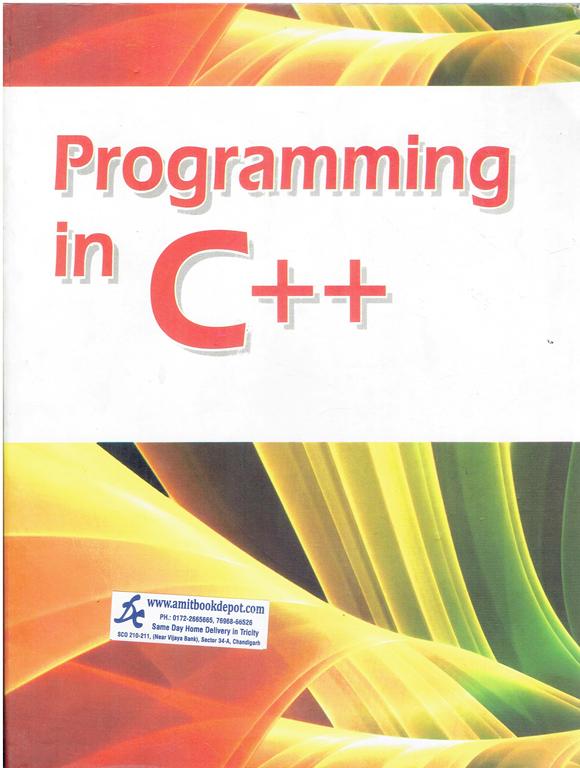
Programming in C++ by Jasbir Singh, Deepak Jyoti, Sonika Narang, and Shikha Chawla (ABS Publications) is a complete guide to object-oriented programming. Covering variables, operators, control structures, functions, classes and objects, inheritance, polymorphism, files and streams, exception handling, templates, and data structures, this book bridges theory and application. It includes detailed chapters on constructors, destructors, operator overloading, and pointers. Designed for university syllabi, it explains invoking Turbo C++ and modern C++ concepts. Ideal for BCA, MCA, B.Tech, and self-learners seeking exam-focused, code-rich content from a reputed publisher.

Yes. Chapter 2 details invoking Turbo C++, while later chapters use standard C++ syntax compatible with GCC, Clang, and MSVC.
Yes. Chapter 9 focuses exclusively on pointers, pointer arithmetic, dynamic allocation, and relationship with arrays, prior to classes and objects.
Yes. Chapter 12 teaches overloading unary/binary operators and type conversion between basic types, objects, and classes.
Chapter 18 introduces stack, queue, singly linked list, and binary search tree using C++ templates and class encapsulation.
Yes. Chapter 7 covers arrays, C-style strings, and string objects, plus arrays of objects before introducing constructors.
Chapter 14 demonstrates compile-time (function overloading) and runtime (virtual functions) polymorphism with abstract base class examples.
Yes. Chapter 15 explains ifstream, ofstream, fstream for text, binary, and random-access file operations with error checking.
Chapter 5 details if-else, switch, loops (for, while, do-while) with C++ specific scoping rules and I/O stream integration.
Chapter 12 assignments include overloading + for matrix addition, << for custom output, and ++ for iterator-like objects.
Yes. Chapter 1 introduces programming fundamentals; subsequent chapters build incrementally from variables to complete data structure implementation.
Yes. Chapter 2 details invoking Turbo C++, while later chapters use standard C++ syntax compatible with GCC, Clang, and MSVC.
Yes. Chapter 9 focuses exclusively on pointers, pointer arithmetic, dynamic allocation, and relationship with arrays, prior to classes and objects.
Yes. Chapter 12 teaches overloading unary/binary operators and type conversion between basic types, objects, and classes.
Chapter 18 introduces stack, queue, singly linked list, and binary search tree using C++ templates and class encapsulation.
Yes. Chapter 7 covers arrays, C-style strings, and string objects, plus arrays of objects before introducing constructors.
Chapter 14 demonstrates compile-time (function overloading) and runtime (virtual functions) polymorphism with abstract base class examples.
Yes. Chapter 15 explains ifstream, ofstream, fstream for text, binary, and random-access file operations with error checking.
Chapter 5 details if-else, switch, loops (for, while, do-while) with C++ specific scoping rules and I/O stream integration.
Chapter 12 assignments include overloading + for matrix addition, << for custom output, and ++ for iterator-like objects.
Yes. Chapter 1 introduces programming fundamentals; subsequent chapters build incrementally from variables to complete data structure implementation.