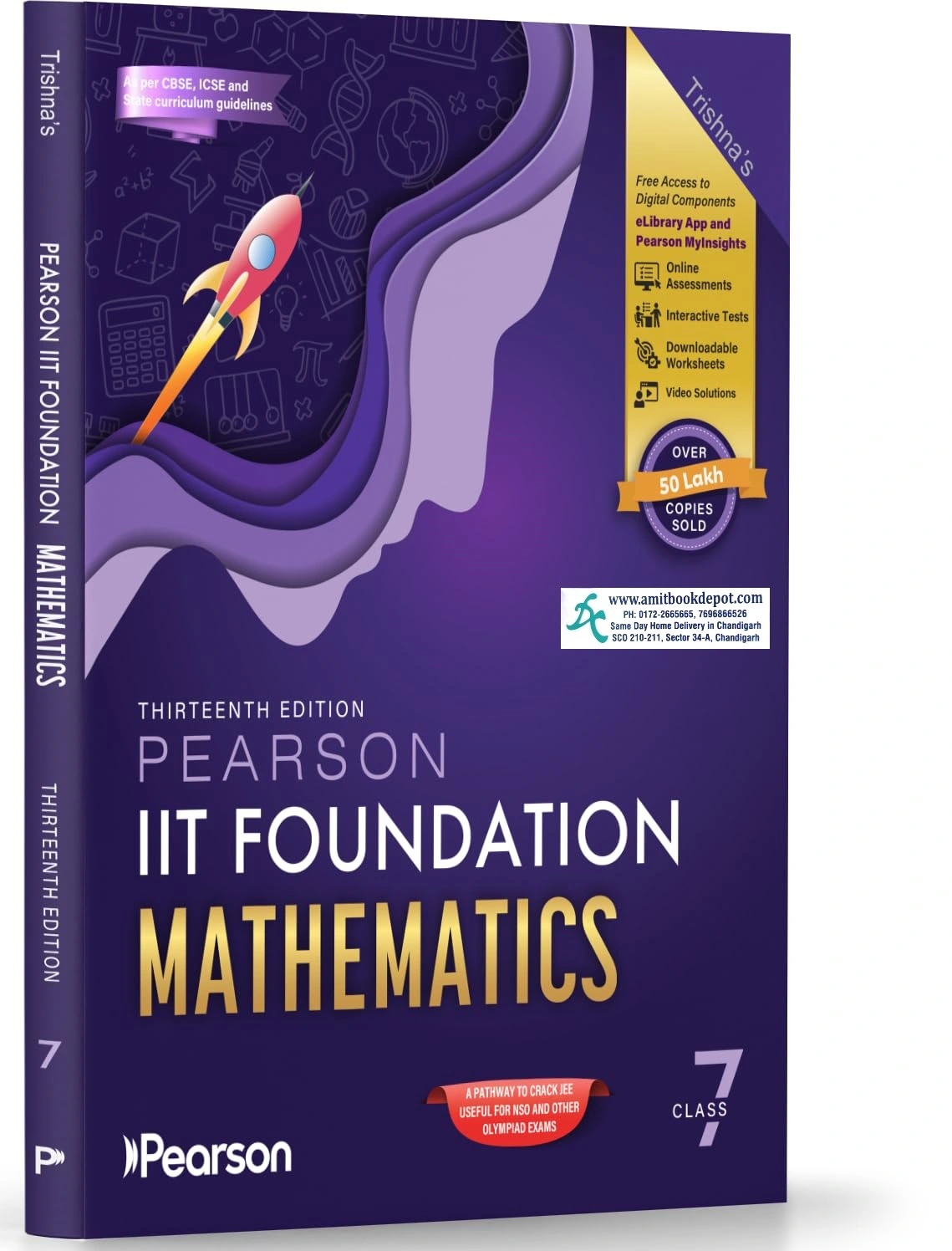
The Pearson IIT Foundation Series Mathematics for Class 7 is a meticulously crafted academic resource designed to build a robust and unshakeable foundation in mathematical concepts. Published by Pearson Education, this book is an integral part of the renowned IIT Foundation Series, specifically tailored for Class 7 students aspiring for future success in competitive exams like IIT-JEE, NTSE, Olympiads, and other engineering entrance tests. It serves as a critical bridge, seamlessly connecting the CBSE, ICSE, and State Board curricula with the advanced problem-solving skills required for higher-level challenges.
This book moves beyond rote learning, emphasizing a deep conceptual understanding and the development of analytical thinking. The content is structured to transition students from middle school mathematics to the more complex realms of abstract thought. Each chapter begins with clear, concise explanations of fundamental principles, breaking down complex topics into easily digestible segments. This methodical approach ensures that learners grasp the ‘why’ behind every formula and theorem, fostering true intellectual mastery rather than temporary memorization.
The table of contents reflects a comprehensive and progressive syllabus. It commences with the building blocks in Chapter 1: Number Systems, thoroughly exploring natural numbers, whole numbers, integers, rational and irrational numbers, and square roots. This strong base is essential for all subsequent mathematical learning. The book then advances to Algebraic Expressions and Special Products (Chapter 2), introducing variables and constants, and progresses to core topics like Ratio and its Applications, Percentage, and Variation (Chapter 3). Chapter 4: Indices delves into exponential expressions, a key area for competitive exams.
A significant portion of the book is dedicated to geometry (Chapter 5), covering triangles, congruence, quadrilaterals, polygons, and circles with an emphasis on proofs and logical reasoning. Chapter 6: Mensuration applies these geometric principles to calculate areas, perimeters, and volumes of both plane figures and solids. The journey into algebra continues with Equations and Their Applications (Chapter 7) and Formulae (Chapter 8), teaching students to model and solve real-world problems. The curriculum is rounded off with Statistics (Chapter 9), covering data interpretation and statistical graphs, and an introduction to logical structures in Chapter 10: Set Theory, including Set Operations and Venn Diagrams.
Key features that distinguish this book include a graded difficulty level in exercises, starting from simple, concept-checking problems to highly challenging HOTS (Higher Order Thinking Skills) questions that mimic the standard of competitive examinations. Detailed, step-by-step solutions for select problems demonstrate the ideal approach and methodology. The language is student-friendly, and diagrams are precise and illustrative, aiding in visual learning. Regular in-chapter exercises and revision tests help in consistent self-assessment and reinforcement of concepts.
For parents and educators, this book is a trustworthy guide that aligns with academic goals while strategically preparing the child for future academic battles. It reduces dependency on multiple reference books by providing an all-in-one, in-depth resource. For the student, it is not just a book but a companion that builds confidence, sharpens intellect, and instills a problem-solving attitude.
Investing in the Pearson IIT Foundation Series Mathematics for Class 7 is an investment in a student’s academic future. It lays the granite-strong foundation necessary to excel not only in the current grade but also to pave a clear and confident path towards achieving dreams in the world of science, technology, and engineering.




















































 (Size 2x1 Feet appx)_1.jpg,photos/uploads/Wooden Study Table (Fixed Legs) (Size 2x1 Feet appx)_2.jpg,photos/uploads/Wooden Study Table (Fixed Legs) (Size 2x1 Feet appx)_3.jpg,photos/uploads/Wooden Study Table (Fixed Legs) (Size 2x1 Feet appx)_4.jpg)