-
Mon-Fri: 10AM to 8PM 01722665665
-
My Account
-
-
0
Total :
₹ 0.00

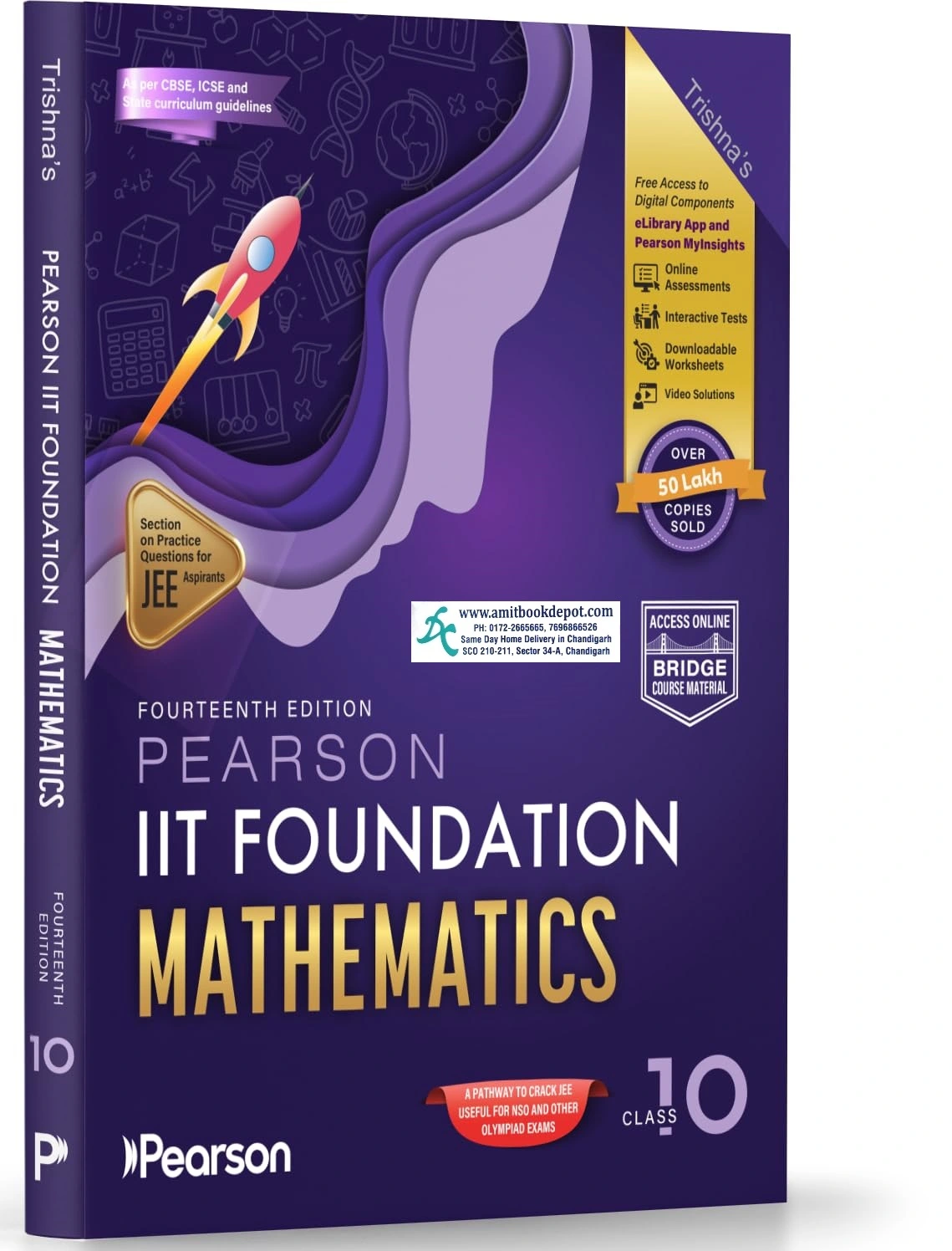
The Pearson IIT Foundation Series Mathematics Class 10 is a comprehensive book designed to build a strong foundation for IIT-JEE, NEET, and other competitive exams alongside the CBSE and ICSE syllabus. It covers essential units from number systems and algebra to geometry, trigonometry, statistics, and commercial mathematics like GST and banking. Its unique Bridge to Grade XI section introduces advanced topics early. With clear explanations, graded problems, and a focus on conceptual clarity, this book is the ideal resource for students aiming for top board scores and a strategic head start in their engineering and medical entrance exam preparation.


It integrates JEE-level problem-solving approaches and advanced concepts within the Class 10 framework, building the analytical thinking and depth of understanding required for the IIT-JEE from an early stage.
Yes, the chapters on Banking, GST, and Shares & Dividends are designed with real-world applications and examples, providing essential financial literacy that is useful beyond academics.
No, it serves as an introductory bridge. It familiarizes students with key topics like Sets, Relations, Functions, and Limits, making the transition to Class 11 smoother and less intimidating.
Absolutely. It uniquely combines theoretical geometry (like Euclid's Geometry, Circles, Locus) with applied mensuration (areas & volumes of 3D shapes like cones, spheres, pyramids), providing a complete understanding.
The chapter is designed to show the interplay between algebra and geometry, teaching students how to represent algebraic equations (like straight lines) geometrically on the coordinate plane.
While these are formally Class 11 topics, early exposure through this bridge section provides a significant competitive edge and conceptual advantage for both board exams and future entrances.
Yes, it comprehensively covers the CBSE/ICSE syllabus with a wide variety of questions, including objective, short-answer, and long-answer types that are essential for board exam preparation.
Yes, it covers logical Statements, Methods of Proof, and Disproof, which are crucial for developing mathematical reasoning and are foundational for computer science and engineering logic.
Yes, the Trigonometry chapter emphasizes application-based learning with problems on Heights and Distances that model real-world scenarios.
Yes, it is structured with a clear progression from concepts to examples to exercises, making it highly suitable for motivated students pursuing self-study.
It integrates JEE-level problem-solving approaches and advanced concepts within the Class 10 framework, building the analytical thinking and depth of understanding required for the IIT-JEE from an early stage.
Yes, the chapters on Banking, GST, and Shares & Dividends are designed with real-world applications and examples, providing essential financial literacy that is useful beyond academics.
No, it serves as an introductory bridge. It familiarizes students with key topics like Sets, Relations, Functions, and Limits, making the transition to Class 11 smoother and less intimidating.
Absolutely. It uniquely combines theoretical geometry (like Euclid's Geometry, Circles, Locus) with applied mensuration (areas & volumes of 3D shapes like cones, spheres, pyramids), providing a complete understanding.
The chapter is designed to show the interplay between algebra and geometry, teaching students how to represent algebraic equations (like straight lines) geometrically on the coordinate plane.
While these are formally Class 11 topics, early exposure through this bridge section provides a significant competitive edge and conceptual advantage for both board exams and future entrances.
Yes, it comprehensively covers the CBSE/ICSE syllabus with a wide variety of questions, including objective, short-answer, and long-answer types that are essential for board exam preparation.
Yes, it covers logical Statements, Methods of Proof, and Disproof, which are crucial for developing mathematical reasoning and are foundational for computer science and engineering logic.
Yes, the Trigonometry chapter emphasizes application-based learning with problems on Heights and Distances that model real-world scenarios.
Yes, it is structured with a clear progression from concepts to examples to exercises, making it highly suitable for motivated students pursuing self-study.