-
Mon-Fri: 10AM to 8PM 01722665665
-
My Account
-
-
0
Total :
₹ 0.00



 (Size 2x1 Feet appx)_1.jpg,photos/uploads/Wooden Study Table (Fixed Legs) (Size 2x1 Feet appx)_2.jpg,photos/uploads/Wooden Study Table (Fixed Legs) (Size 2x1 Feet appx)_3.jpg,photos/uploads/Wooden Study Table (Fixed Legs) (Size 2x1 Feet appx)_4.jpg)


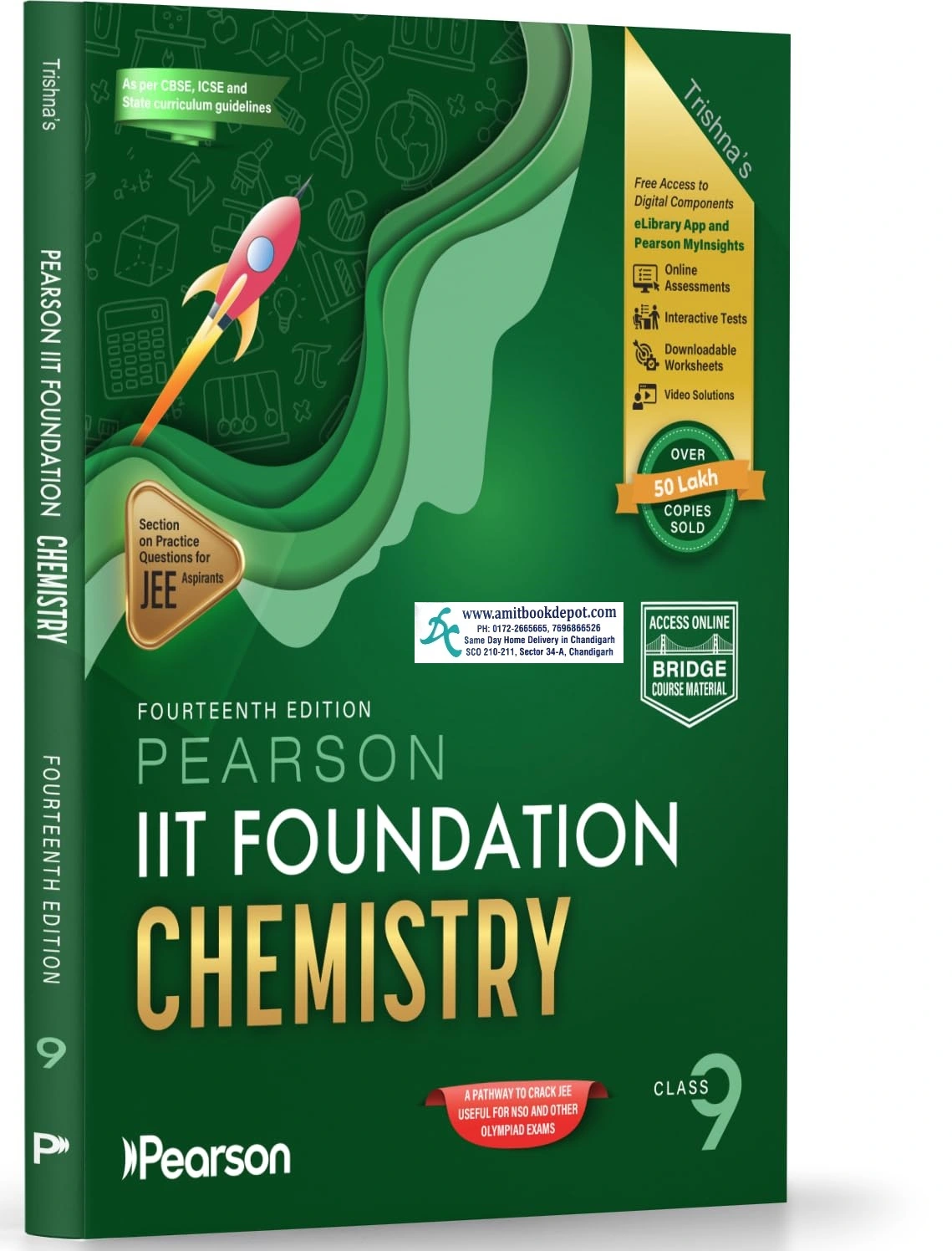
Yes. It is uniquely structured to explain the core Class 9 syllabus with the depth and application-based approach required for foundational preparation for IIT-JEE, NEET, and Olympiads. The concepts are built from the ground up to serve both purposes simultaneously.
These topics are introduced in a conceptual, foundational manner, avoiding excessive complexity. The focus is on building the core idea (e.g., what is reaction rate, what are quantum numbers for) to create a strong base for deeper study in higher classes, not on overwhelming the student.
It provides comprehensive Answer Keys and separate Hints and Explanations. This dual approach allows you to check your answer first and then understand the reasoning and method behind solving the problem.
The book emphasizes a strong link between theory and application. Chapters like Mole Concept and Gas Laws are rich with numerical problems, while others like Periodic Table focus on conceptual understanding and comparative analysis, all essential for problem-solving.
Yes. Topics such as Paper Chromatography, Hardness of Water, and Electrolysis are explained with their principles and practical significance, helping students connect textbook chemistry to real-life phenomena and industrial processes.
Chapter 4 (Atomic Structure) deliberately takes a historical journey—from Thomson to Rutherford to Bohr and finally the quantum mechanical model. This helps students appreciate how scientific understanding evolves and solidifies the logic behind complex concepts like orbitals.
The language is clear and systematic. Complex ideas are broken down into logical subsections. Combined with the detailed hints, it is designed to be a self-contained guide for motivated students.
Absolutely. Each bond type is defined with formation mechanisms, typical properties, and common examples, with special emphasis on understanding polarity and the unique nature of hydrogen bonding and coordinate bonds.
Yes. The book includes well-labeled, clear diagrams and illustrations that are essential for visualizing abstract concepts (like orbital shapes) and complex processes (like the metallurgy of iron in a blast furnace).
It delves into conceptual explanations. It covers solubility curves and their interpretation, the science behind colloids, and the difference between efflorescence and deliquescence, moving beyond rote learning.
Yes. It is uniquely structured to explain the core Class 9 syllabus with the depth and application-based approach required for foundational preparation for IIT-JEE, NEET, and Olympiads. The concepts are built from the ground up to serve both purposes simultaneously.
These topics are introduced in a conceptual, foundational manner, avoiding excessive complexity. The focus is on building the core idea (e.g., what is reaction rate, what are quantum numbers for) to create a strong base for deeper study in higher classes, not on overwhelming the student.
It provides comprehensive Answer Keys and separate Hints and Explanations. This dual approach allows you to check your answer first and then understand the reasoning and method behind solving the problem.
The book emphasizes a strong link between theory and application. Chapters like Mole Concept and Gas Laws are rich with numerical problems, while others like Periodic Table focus on conceptual understanding and comparative analysis, all essential for problem-solving.
Yes. Topics such as Paper Chromatography, Hardness of Water, and Electrolysis are explained with their principles and practical significance, helping students connect textbook chemistry to real-life phenomena and industrial processes.
Chapter 4 (Atomic Structure) deliberately takes a historical journey—from Thomson to Rutherford to Bohr and finally the quantum mechanical model. This helps students appreciate how scientific understanding evolves and solidifies the logic behind complex concepts like orbitals.
The language is clear and systematic. Complex ideas are broken down into logical subsections. Combined with the detailed hints, it is designed to be a self-contained guide for motivated students.
Absolutely. Each bond type is defined with formation mechanisms, typical properties, and common examples, with special emphasis on understanding polarity and the unique nature of hydrogen bonding and coordinate bonds.
Yes. The book includes well-labeled, clear diagrams and illustrations that are essential for visualizing abstract concepts (like orbital shapes) and complex processes (like the metallurgy of iron in a blast furnace).
It delves into conceptual explanations. It covers solubility curves and their interpretation, the science behind colloids, and the difference between efflorescence and deliquescence, moving beyond rote learning.